Zero Magnetic Field on Loop Axis Due to Loop and Parallel Wires
As illustrated in the diagram, a circular conducting loop of radius lies in the plane of the paper along with two long parallel wires (labeled 1 and 2). Both wires are situated at a distance from the center of the loop. Each wire as well as the circular loop carries an identical current . Looking from above, the current circulating in the loop flows in the counterclockwise direction.
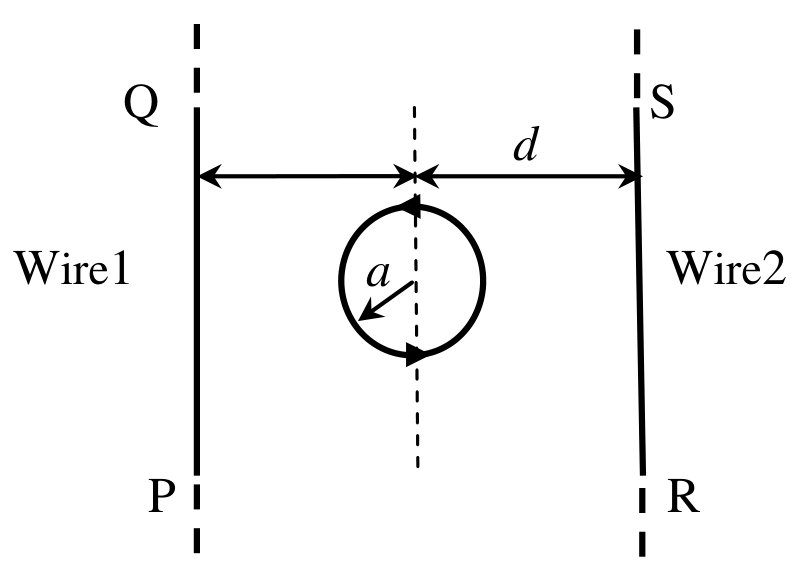
In the case where (with the wires remaining electrically insulated from the circular loop), the total magnetic field vanishes on the axis of the loop at a vertical height above its plane. Under these conditions:
Options
the currents in wire 1 and wire 2 are directed along and , respectively, and
the currents in wire 1 and wire 2 are directed along and , respectively, and
the currents in wire 1 and wire 2 are directed along and , respectively, and
the currents in wire 1 and wire 2 are directed along and , respectively, and
Topics & Concepts
Step-by-Step Solution
To find the direction of the currents and the height at which the total magnetic field vanishes, we set up a Cartesian coordinate system:
- Let the plane of the paper be the -plane, with the center of the circular loop at the origin .
- The axis of the loop lies along the -axis, where "above the plane" corresponds to the positive -direction ().
- Wire 1 lies along the line , parallel to the -axis (directed from to ).
- Wire 2 lies along the line , parallel to the -axis (with points and along it).
1. Magnetic Field Due to the Circular Loop
The current in the loop flows counterclockwise as viewed from above (looking down along the direction). By the right-hand rule, the magnetic field along the loop's axis at a height () points in the direction:
2. Magnetic Field Due to the Parallel Wires
For the net magnetic field on the axis at to be zero, the combined magnetic field of the two wires, , must be directed entirely along to cancel , meaning any horizontal component must sum to zero.
Let the position vectors of the field point relative to Wire 1 and Wire 2 be:
- If the current in Wire 1 flows along (the direction), the magnetic field is:
- For the -components to cancel and the -components to reinforce in the direction, the current in Wire 2 must be directed along (the direction):
The resultant magnetic field of the two wires is:
Thus, the currents in Wire 1 and Wire 2 must be directed along and , respectively.
3. Calculating the Height
Equating the magnitude of the magnetic field from the loop to the magnitude of the field from the wires:
Given :
Simplifying:
Squaring both sides:
Therefore, the currents in wire 1 and wire 2 are directed along and , respectively, and .
Correct Option: C