Dependence of Liquid Spray Rate on Densities
A spray gun model is illustrated in the diagram, where a piston drives air through an ejection nozzle. A narrow tube with uniform cross-sectional area connects to this nozzle, having its lower end submerged in a small liquid reservoir. When air is expelled through the nozzle by the piston, the liquid is drawn up from the vessel into the nozzle and sprayed out into the environment. In this arrangement, the radius of the piston cylinder is while that of the nozzle is . The top of the reservoir remains exposed to the atmosphere.
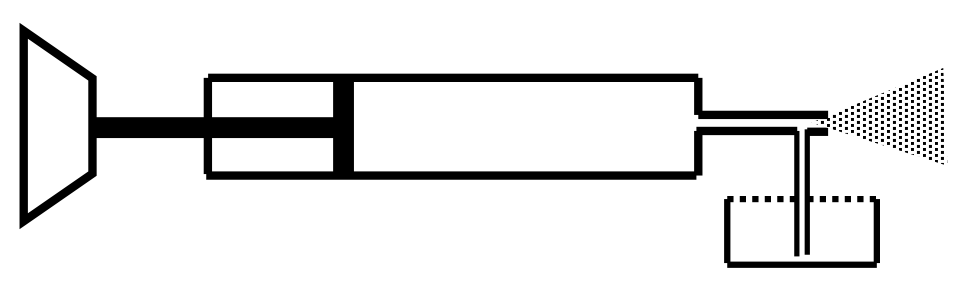
Given that the density of air is and the liquid density is , the volumetric rate at which the liquid is sprayed out, for a predetermined piston speed, is proportional to
Options
Topics & Concepts
Step-by-Step Solution
To determine the dependence of the volumetric rate of liquid sprayed on the densities of air and liquid, we apply Bernoulli's principle.
1. Pressure Drop Created by the Air Flow: Let the speed of the piston be , the cross-sectional area of the cylinder be , and the cross-sectional area of the nozzle be . By the equation of continuity for air (assuming it to be incompressible at low speeds): For a given piston speed, the velocity of the air rushing through the nozzle, , is constant.
Applying Bernoulli's principle to the airflow, the high-velocity air at the nozzle produces a localized reduction in pressure compared to the atmospheric pressure :
2. Flow of Liquid through the Tube: The surface of the liquid in the reservoir is exposed to the atmosphere at pressure , while the top end of the tube opening inside the nozzle experiences the reduced pressure .
Applying Bernoulli's equation to the liquid drawn up the vertical tube of negligible or fixed height :
Neglecting the hydrostatic term relative to the dynamic pressure, or considering the dynamic pressure difference driving the flow:
Equating the two expressions for the pressure difference :
Solving for the speed of the liquid :
3. Volumetric Flow Rate of the Liquid: The volumetric rate at which the liquid is sprayed out is given by:
Since and are constants for a predetermined piston speed, the rate is proportional to:
Therefore, the correct option is (A).