Work Done Moving Mass from Axis of Annular Disc to Infinity
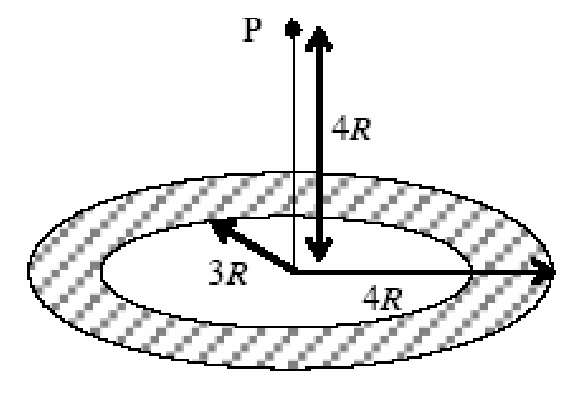
A thin uniform annular disc (see figure) of mass M has outer radius 4R and inner radius 3R. The work required to take a unit mass from point P on its axis to infinity is
To find the work required to move a unit mass from point P on the axis of the annular disc to infinity, we first need to determine the gravitational potential at point P.
1. Surface Mass Density of the Annular Disc
The outer radius of the disc is R2=4R and the inner radius is R1=3R.
The total surface area of the annular disc is: A=πR22−πR12=π(4R)2−π(3R)2=7πR2
Thus, the surface mass density σ of the disc is: σ=AM=7πR2M
2. Gravitational Potential at Point P
Point P lies on the central axis of the disc at a distance z=4R from its center.
Consider a thin circular ring element of radius r and thickness dr centered on the disc. The mass of this element is: dm=σ⋅(2πrdr)
The gravitational potential dV at point P due to this differential ring element is: dV=−r2+z2Gdm=−r2+z22πGσrdr
Integrating dV over the entire annular disc from r=3R to r=4R: VP=−2πGσ∫3R4Rr2+z2rdr
Using the integration rule ∫r2+z2rdr=r2+z2: VP=−2πGσ[r2+z2]3R4R
Substituting the value of σ=7πR2M: VP=−2πG(7πR2M)R(42−5) VP=−7R2GM(42−5)
3. Calculation of Work Done
The work required by an external agent to take a unit mass (m=1) from point P to infinity (r→∞) slowly is given by the change in gravitational potential energy: W=U(∞)−U(P)=m(V∞−VP)