Electric Field Lines and Charge Magnitude Relationship
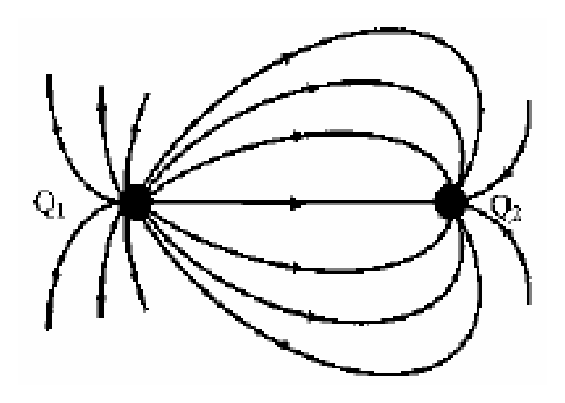
A few electric field lines for a system of two charges and fixed at two different points on the x-axis are shown in the figure. These lines suggest that
Options
A
Correct
B
C
at a finite distance to the left of the electric field is zero
DCorrect
at a finite distance to the right of the electric field is zero
Topics & Concepts
Step-by-Step Solution
Based on the provided electric field lines diagram:
-
Sign and Magnitude of Charges:
- The electric field lines originate from charge and terminate on charge . This implies that is a positive charge and is a negative charge.
- The number of electric field lines originating from or terminating on a charge is directly proportional to the magnitude of that charge ().
- In the figure, a larger number of field lines originate from than the number of lines terminating on (several lines from extend out to infinity). Therefore:
- Hence, Option (A) is correct and Option (B) is incorrect.
-
Location of the Neutral Point ():
- The charges have opposite signs, so their electric fields between them point in the same direction (from the positive charge towards the negative charge ). Consequently, the electric field cannot be zero between the two charges.
- Outside the charges along the line joining them, the fields due to and point in opposite directions. The net electric field can be zero where the magnitudes of the two fields are equal:
- Since , we must have for the fields to cancel each other out.
- For points to the left of , any point is closer to than to (). Because and , the field due to is strictly greater than that due to at all points to the left of , meaning the field can never be zero there. Thus, Option (C) is incorrect.
- For points to the right of , any point is closer to than to (). Thus, the condition is satisfied, and there exists a finite distance to the right of where the two opposing electric fields cancel each other completely. Hence, Option (D) is correct.
Correct Options: A and D