JEE Challenger
More from Thermodynamics

Work Done in Thermodynamic Processes in PV Diagram

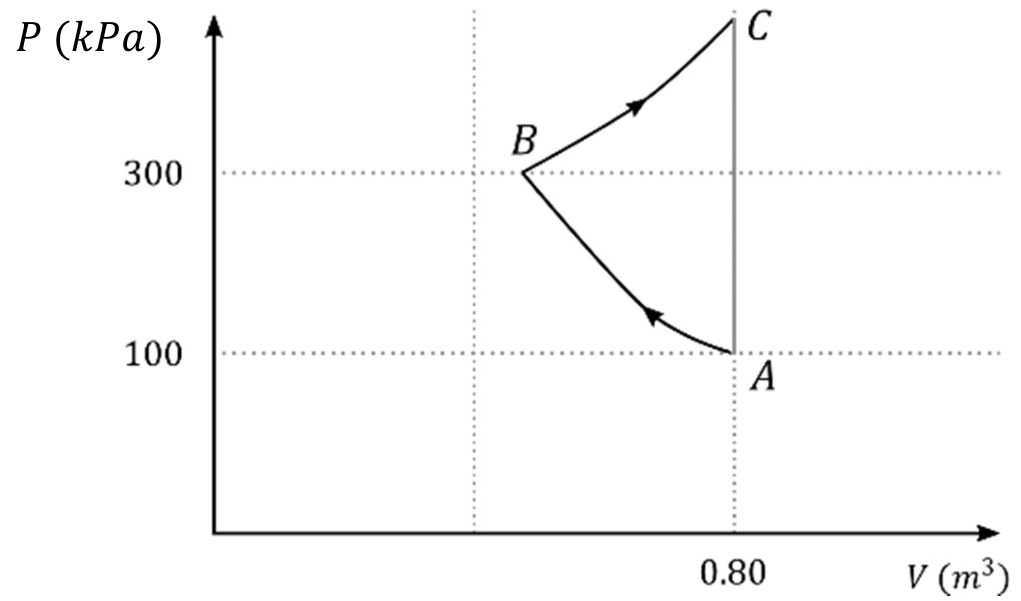
In the given P−VP-V diagram, a monoatomic gas (γ=53)\left(\gamma = \frac{5}{3}\right) is first compressed adiabatically from state AA to state BB. Then it expands isothermally from state BB to state CC. [Given: (13)0.6≃0.5\left(\frac{1}{3}\right)^{0.6} \simeq 0.5, ln⁡2≃0.7\ln 2 \simeq 0.7].

Which of the following statement(s) is(are) correct?

Question Diagram 1

Options

A

The magnitude of the total work done in the process A→B→CA \rightarrow B \rightarrow C is 144 kJ144\text{ kJ}.

B

The magnitude of the work done in the process B→CB \rightarrow C is 84 kJ84\text{ kJ}.

Correct
C

The magnitude of the work done in the process A→BA \rightarrow B is 60 kJ60\text{ kJ}.

Correct
D

The magnitude of the work done in the process C→AC \rightarrow A is zero.

Correct

Step-by-Step Solution

To determine the correct statements, we analyze each thermodynamic process shown in the P−VP-V diagram.

1. State Parameters:

From the given P−VP-V diagram:

  • State AA: PA=100 kPa=105 PaP_A = 100\text{ kPa} = 10^5\text{ Pa} VA=0.80 m3V_A = 0.80\text{ m}^3

  • State BB: PB=300 kPa=3×10⁵ PaP_B = 300\text{ kPa} = 3 \times 10^5\text{ Pa}


2. Process A→BA \rightarrow B (Adiabatic Compression):

Since the process A→BA \rightarrow B is adiabatic (γ=5/3\gamma = 5/3), the equation of state is: PAVAγ=PBVBγP_A V_A^\gamma = P_B V_B^\gamma

Substituting the given values: 100×(0.80)5/3=300×VB5/3100 \times (0.80)^{5/3} = 300 \times V_B^{5/3}

VB5/3=(0.80)5/3×(100300)=(0.80)5/3×13V_B^{5/3} = (0.80)^{5/3} \times \left(\frac{100}{300}\right) = (0.80)^{5/3} \times \frac{1}{3}

VB=0.80×(13)3/5=0.80×(13)0.6V_B = 0.80 \times \left(\frac{1}{3}\right)^{3/5} = 0.80 \times \left(\frac{1}{3}\right)^{0.6}

Given that (13)0.6≃0.5\left(\frac{1}{3}\right)^{0.6} \simeq 0.5: VB=0.80×0.5=0.40 m3V_B = 0.80 \times 0.5 = 0.40\text{ m}^3

The work done in an adiabatic process is given by: WA→B=PAVA−PBVBγ−1W_{A \rightarrow B} = \frac{P_A V_A - P_B V_B}{\gamma - 1}

Substituting the values: PAVA=100 kPa×0.80 m3=80 kJP_A V_A = 100\text{ kPa} \times 0.80\text{ m}^3 = 80\text{ kJ} PBVB=300 kPa×0.40 m3=120 kJP_B V_B = 300\text{ kPa} \times 0.40\text{ m}^3 = 120\text{ kJ} γ−1=53−1=23\gamma - 1 = \frac{5}{3} - 1 = \frac{2}{3}

WA→B=80 kJ−120 kJ2/3=−402/3=−60 kJW_{A \rightarrow B} = \frac{80\text{ kJ} - 120\text{ kJ}}{2/3} = \frac{-40}{2/3} = -60\text{ kJ}

The magnitude of the work done in process A→BA \rightarrow B is: ∣WA→B∣=60 kJ|W_{A \rightarrow B}| = 60\text{ kJ}

Thus, Option C is correct.


3. Process B→CB \rightarrow C (Isothermal Expansion):

From the P−VP-V diagram, State CC has the same volume as State AA, so: VC=VA=0.80 m3V_C = V_A = 0.80\text{ m}^3

The work done during the isothermal expansion B→CB \rightarrow C at temperature TBT_B is: WB→C=nRTBln⁡(VCVB)=PBVBln⁡(VCVB)W_{B \rightarrow C} = n R T_B \ln\left(\frac{V_C}{V_B}\right) = P_B V_B \ln\left(\frac{V_C}{V_B}\right)

Substituting PBVB=120 kJP_B V_B = 120\text{ kJ}, VC=0.80 m3V_C = 0.80\text{ m}^3, VB=0.40 m3V_B = 0.40\text{ m}^3, and ln⁡2≃0.7\ln 2 \simeq 0.7: WB→C=120 kJ×ln⁡(0.800.40)=120×ln⁡(2)≈120×0.7=84 kJW_{B \rightarrow C} = 120\text{ kJ} \times \ln\left(\frac{0.80}{0.40}\right) = 120 \times \ln(2) \approx 120 \times 0.7 = 84\text{ kJ}

The magnitude of the work done in process B→CB \rightarrow C is: ∣WB→C∣=84 kJ|W_{B \rightarrow C}| = 84\text{ kJ}

Thus, Option B is correct.


4. Total Work Done in A→B→CA \rightarrow B \rightarrow C:

WA→B→C=WA→B+WB→C=−60 kJ+84 kJ=+24 kJW_{A \rightarrow B \rightarrow C} = W_{A \rightarrow B} + W_{B \rightarrow C} = -60\text{ kJ} + 84\text{ kJ} = +24\text{ kJ}

The magnitude of the total work done is ∣WA→B→C∣=24 kJ≠144 kJ|W_{A \rightarrow B \rightarrow C}| = 24\text{ kJ} \neq 144\text{ kJ}.

Thus, Option A is incorrect.


5. Process C→AC \rightarrow A (Isochoric Process):

From the diagram, the path C→AC \rightarrow A is a vertical line on the P−VP-V diagram, meaning VC=VA=0.80 m3V_C = V_A = 0.80\text{ m}^3 (volume is constant).

WC→A=∫VCVAP dV=0 kJW_{C \rightarrow A} = \int_{V_C}^{V_A} P \, dV = 0\text{ kJ}

The magnitude of the work done in process C→AC \rightarrow A is zero.

Thus, Option D is correct.


Conclusion:

The correct statements are B, C, and D.
Work Done in Thermodynamic Processes in PV Diagram | Physics PYQ Solution - JEE Challenger