Angular Momentum of Rolling Disk on Circular Path
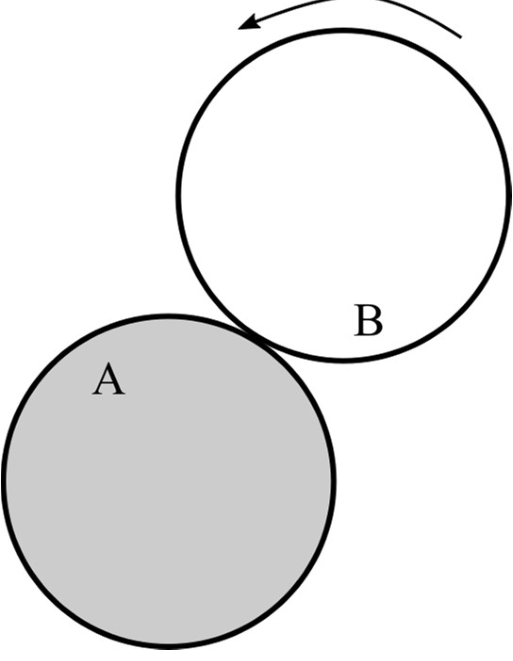
Consider a flat surface of a thin uniform disk having radius that is fixed to a horizontal table. Another thin uniform disk with mass and radius rolls without slipping along the circumference of , as illustrated in the figure. A flat surface of also lies on the plane of the table. The center of mass of disk rotates with a constant angular speed around the vertical axis passing through the center of . If the angular momentum of relative to the center of is given by , then what is the value of ?
Options
2
5
Step-by-Step Solution
To find the value of , we calculate the angular momentum of disk relative to the center of fixed disk (denoted as ).
1. Kinematics of Disk
- Radius of disk
- Radius of disk
- Distance from the center of disk () to the center of mass of disk () is:
The center of mass rotates about with a constant angular speed . Therefore, the magnitude of the linear velocity of is:
In vector form, using polar coordinates centered at :
2. Angular Velocity of Disk ()
Let be the absolute spin angular velocity of disk about its own center of mass .
The point of contact on disk is located at a vector position relative to . Since disk rolls without slipping on the fixed disk , the velocity of point must be zero:
Substituting the known values:
Solving for :
Thus, the absolute angular velocity of disk is .
3. Angular Momentum of Disk Relative to
By Koenig's theorem, the total angular momentum of a rigid body about an origin is the sum of its spin angular momentum about its center of mass and the orbital angular momentum of its center of mass relative to :
-
Spin Angular Momentum (): For a thin uniform disk of mass and radius , the moment of inertia about its central vertical axis is .
-
Orbital Angular Momentum ():
Combining both parts:
The magnitude of the angular momentum of disk relative to the center of is:
Comparing this with , we find:
Correct Answer: (B) 5