Interference Pattern of Double Slit in Two Media Interface
A double slit setup is shown in the figure. One of the slits is in medium 2 of refractive index . The other slit is at the interface of this medium with another medium 1 of refractive index . The line joining the slits is perpendicular to the interface and the distance between the slits is . The slit widths are much smaller than . A monochromatic parallel beam of light is incident on the slits from medium 1. A detector is placed in medium 2 at a large distance from the slits, and at an angle from the line joining them, so that equals the angle of refraction of the beam. Consider two approximately parallel rays from the slits received by the detector.
Which of the following statement(s) is(are) correct?
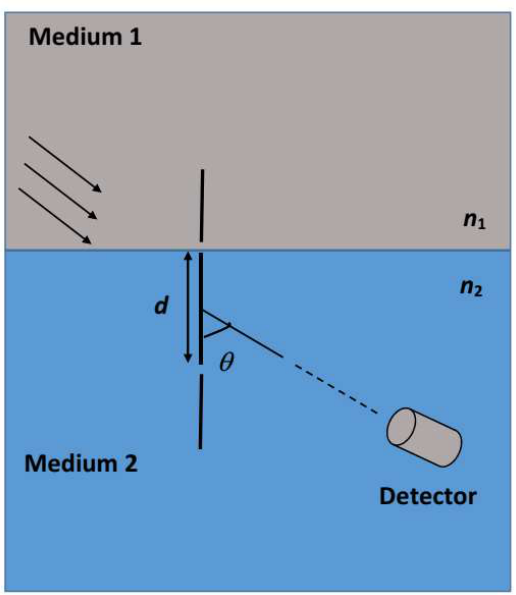
Options
The phase difference between the two rays is independent of .
The two rays interfere constructively at the detector.
The phase difference between the two rays depends on but is independent of .
The phase difference between the two rays vanishes only for certain values of and the angle of incidence of the beam, with being the corresponding angle of refraction.
Topics & Concepts
Step-by-Step Solution
To determine the correct statements, we analyze the optical path length (OPL) of the two rays traveling from the incident parallel beam in Medium 1 to the detector in Medium 2.
1. Coordinate Setup and Snell's Law
Let the interface between Medium 1 (refractive index ) and Medium 2 (refractive index ) lie along the horizontal axis . The line joining the slits is perpendicular to the interface, which we define as the vertical axis .
- Slit 1 () is located at the interface: .
- Slit 2 () is located inside Medium 2 at a distance along the vertical axis: .
A parallel beam of monochromatic light in Medium 1 is incident on the interface at an angle relative to the normal (the line ). By Snell's law, the angle of refraction in Medium 2 satisfies:
The detector is placed in Medium 2 at a large distance from the slits at an angle relative to the line . The unit vector in the direction of the detector is:
2. Optical Path Length (OPL) from Incident Wavefront to the Slits
Consider a plane wavefront of the incident beam in Medium 1. Let the wavefront pass through as our reference point, where .
-
For Ray 1:
-
For Ray 2: The incident plane wave refracts at the interface and enters Medium 2 as a plane wave propagating in the direction . Since the refracted wavefront in Medium 2 passes through , the perpendicular distance from to the wavefront passing through along the direction of propagation is given by the projection of onto :
Since this propagation occurs entirely within Medium 2, the optical path length from the incident wavefront to is:
3. Optical Path Length from the Slits to the Detector
-
For Ray 1: Ray 1 diffracts from and travels a physical distance in Medium 2 to reach the detector wavefront:
-
For Ray 2: Ray 2 diffracts from and travels towards the detector along the direction . Because is advanced towards the detector by relative to , the remaining physical distance to the detector wavefront is :
4. Total Optical Path Lengths and Phase Difference
Calculating the total optical path length for each ray from the incident wavefront to the detector:
-
Ray 1:
-
Ray 2:
The total optical path difference between the two rays is:
Thus, the phase difference between the two rays at the detector is:
5. Evaluation of Options
-
(A) The phase difference between the two rays is independent of : Since identically for any slit separation , it is independent of . (Correct)
-
(B) The two rays interfere constructively at the detector: Since , the two rays arrive at the detector in phase, leading to constructive interference. (Correct)
-
(C) The phase difference between the two rays depends on but is independent of : Since constantly, it does not depend on . (Incorrect)
-
(D) The phase difference between the two rays vanishes only for certain values of ...: holds for all values of , not just specific values. (Incorrect)
Conclusion
The correct options are A and B.