JEE Challenger
More from Units and Measurements

Vernier Caliper Readings for Different Scale Configurations

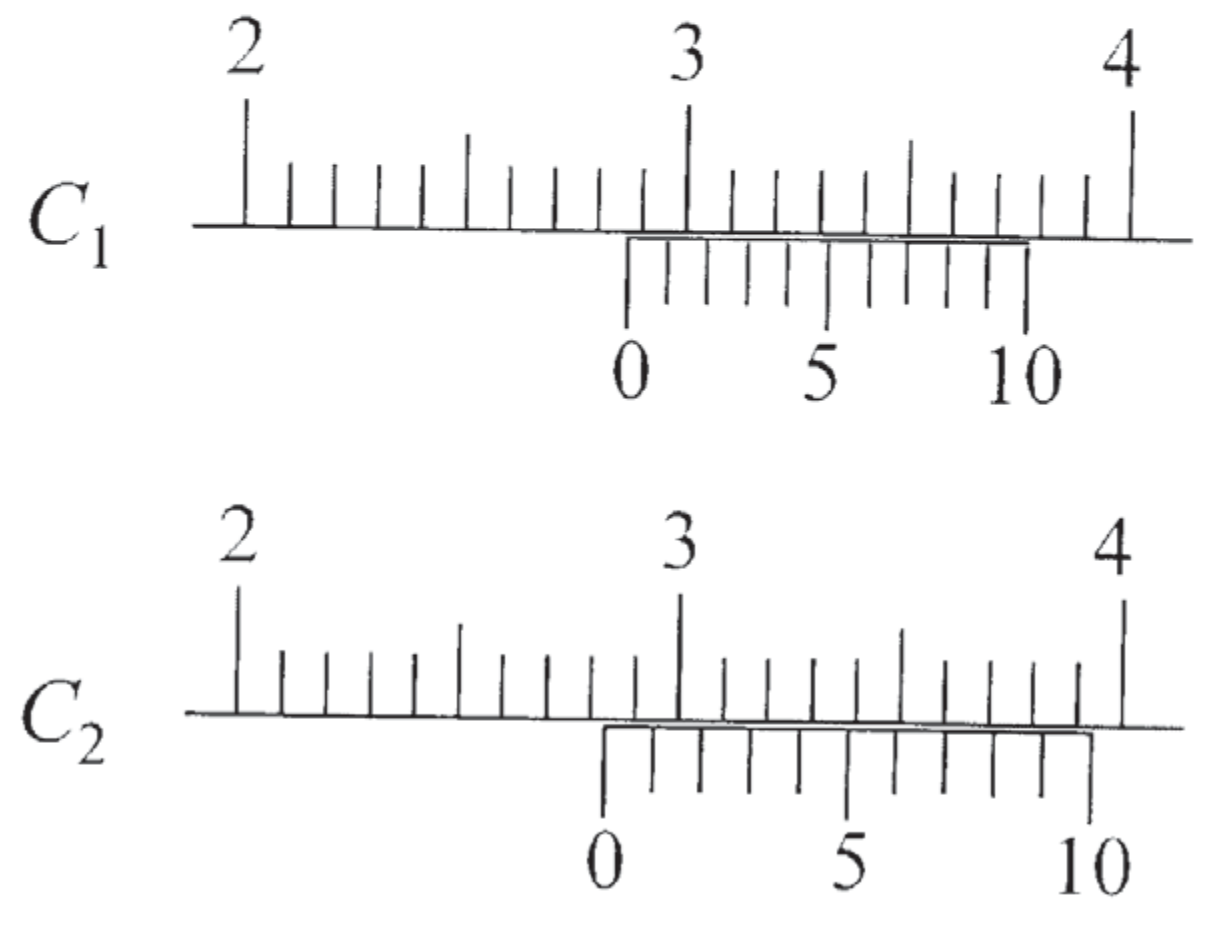
Consider two Vernier calipers, both having 1 cm1\text{ cm} divided into 1010 equal divisions on their main scale. The Vernier scale of caliper C1C_1 consists of 1010 equal divisions corresponding to 99 main scale divisions. The Vernier scale of caliper C2C_2 consists of 1010 equal divisions corresponding to 1111 main scale divisions. The readings obtained from these two calipers are depicted in the figure. What are the measured values (in cm\text{cm}) obtained by calipers C1C_1 and C2C_2, respectively?

Question Diagram 1

Options

A

2.85 and 2.82

B

2.87 and 2.83

Correct
C

2.87 and 2.86

D

2.87 and 2.87

Step-by-Step Solution

To determine the measured values for both Vernier calipers, we first establish the value of one Main Scale Division (MSD\text{MSD}) for both instruments:

1 MSD=1 cm10=0.1 cm=1 mm1\text{ MSD} = \frac{1\text{ cm}}{10} = 0.1\text{ cm} = 1\text{ mm}


1. Calculation for Caliper C1C_1 (Standard Vernier Scale):

For caliper C1C_1, 1010 Vernier Scale Divisions (VSD1\text{VSD}_1) correspond to 9 MSD9\text{ MSD}: 10 VSD1=9 MSD=0.9 cm10\text{ VSD}_1 = 9\text{ MSD} = 0.9\text{ cm} 1 VSD1=0.09 cm=0.9 mm1\text{ VSD}_1 = 0.09\text{ cm} = 0.9\text{ mm}

The Least Count (LC1\text{LC}_1) of C1C_1 is: LC1=1 MSD−1 VSD1=0.1 cm−0.09 cm=0.01 cm\text{LC}_1 = 1\text{ MSD} - 1\text{ VSD}_1 = 0.1\text{ cm} - 0.09\text{ cm} = 0.01\text{ cm}

From the diagram for caliper C1C_1:

  • The zero mark of the Vernier scale lies between 2.8 cm2.8\text{ cm} and 2.9 cm2.9\text{ cm}, so the Main Scale Reading is: MSR1=2.8 cm\text{MSR}_1 = 2.8\text{ cm}
  • The 7th7^\text{th} division of the Vernier scale coincides with a mark on the main scale (at 3.5 cm3.5\text{ cm}).

Thus, the measured value for caliper C1C_1 is: Reading1=MSR1+(N1×LC1)=2.8 cm+(7×0.01 cm)=2.87 cm\text{Reading}_1 = \text{MSR}_1 + (N_1 \times \text{LC}_1) = 2.8\text{ cm} + (7 \times 0.01\text{ cm}) = 2.87\text{ cm}


2. Calculation for Caliper C2C_2 (Retrograde Vernier Scale):

For caliper C2C_2, 1010 Vernier Scale Divisions (VSD2\text{VSD}_2) correspond to 11 MSD11\text{ MSD}: 10 VSD2=11 MSD=1.1 cm10\text{ VSD}_2 = 11\text{ MSD} = 1.1\text{ cm} 1 VSD2=0.11 cm=1.1 mm1\text{ VSD}_2 = 0.11\text{ cm} = 1.1\text{ mm}

Since 1 VSD2>1 MSD1\text{ VSD}_2 > 1\text{ MSD}, this is a retrograde Vernier scale.

From the diagram for caliper C2C_2:

  • The zero of the Vernier scale lies between 2.8 cm2.8\text{ cm} and 2.9 cm2.9\text{ cm}.
  • The 7th7^\text{th} division of the Vernier scale aligns perfectly with the 3.6 cm3.6\text{ cm} mark on the main scale.

The position of the zero mark on the Vernier scale (the measured value) is calculated by subtracting the length of 7 VSD27\text{ VSD}_2 from the coinciding main scale position: Reading2=3.6 cm−(7×1 VSD2)=3.6 cm−(7×0.11 cm)=3.6 cm−0.77 cm=2.83 cm\text{Reading}_2 = 3.6\text{ cm} - (7 \times 1\text{ VSD}_2) = 3.6\text{ cm} - (7 \times 0.11\text{ cm}) = 3.6\text{ cm} - 0.77\text{ cm} = 2.83\text{ cm}

Alternatively, using the formula for a retrograde Vernier scale: Reading2=(MSR2+1 MSD)−N2×(1 VSD2−1 MSD)\text{Reading}_2 = (\text{MSR}_2 + 1\text{ MSD}) - N_2 \times (1\text{ VSD}_2 - 1\text{ MSD}) Reading2=2.9 cm−7×(0.11 cm−0.10 cm)=2.9 cm−0.07 cm=2.83 cm\text{Reading}_2 = 2.9\text{ cm} - 7 \times (0.11\text{ cm} - 0.10\text{ cm}) = 2.9\text{ cm} - 0.07\text{ cm} = 2.83\text{ cm}


Conclusion:

The measured values obtained by calipers C1C_1 and C2C_2 are 2.87 cm2.87\text{ cm} and 2.83 cm2.83\text{ cm}, respectively.

Correct Option: B