Angular Momentum of Rolling Discs Assembly Connected by Rod
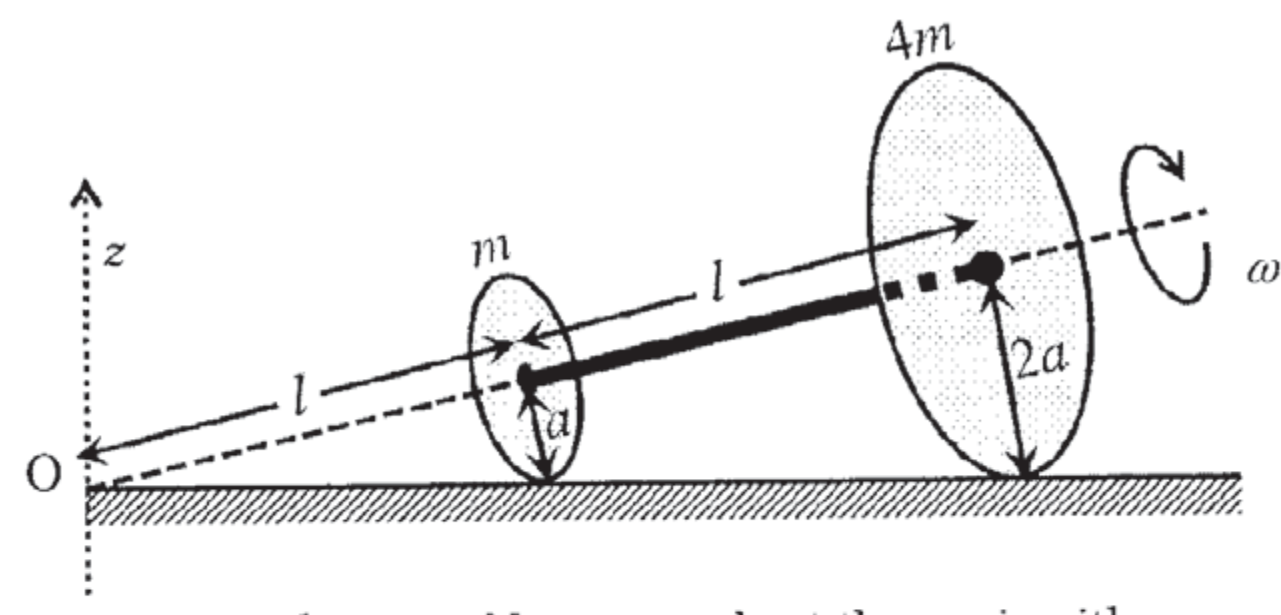
Two thin circular discs with masses and , and radii and respectively, are rigidly attached at their centers by a light, rigid rod of length . This assembly is placed on a firm, horizontal surface and rolls without slipping such that its angular speed around the rod's axis is . If denotes the total angular momentum of the entire assembly relative to the origin point 'O' (as depicted in the diagram), which of the following statements is/are correct?
Options
The center of mass of the assembly precesses about the -axis with an angular speed of
The magnitude of the angular momentum of the center of mass of the assembly about point O is
The magnitude of the angular momentum of the assembly about its center of mass is
The magnitude of the -component of is
Step-by-Step Solution
To determine the correct statements, we analyze the geometry and rotational dynamics of the assembly step-by-step.
1. Geometry of the Assembly
Let:
- Mass of Disc 1: , Radius .
- Mass of Disc 2: , Radius .
- Horizontal distance between the centers of the discs: .
The height of the center of Disc 1 above the horizontal plane is , and the height of the center of Disc 2 is . The vertical distance between their centers is:
The distance between the centers of the two discs along the rigid rod is:
Let be the angle of inclination of the rod axis relative to the horizontal ground:
Since the extension of the rod passes through the origin on the ground, the distances of the centers of Disc 1 () and Disc 2 () from along the rod axis are:
2. Precession Angular Speed (Statement A)
The assembly rolls without slipping on the horizontal surface, precessing about the vertical -axis passing through with an angular speed .
The condition for rolling without slipping relates the spin angular speed about the rod's axis to the precession angular speed :
Therefore, Statement (A) is correct.
3. Position and Angular Momentum of the Center of Mass (Statement B)
The position of the Center of Mass (CM) of the system along the rod axis from is:
The total mass of the assembly is . The distance of the CM from the vertical -axis is:
The linear speed of the CM due to precession is:
The magnitude of the angular momentum of the center of mass about point is:
Therefore, Statement (B) is incorrect.
4. Angular Momentum about the Center of Mass (Statement C)
Relative to the center of mass, the positions of the two discs along the rod axis are:
- Disc 1:
- Disc 2:
The moments of inertia of the discs about the rod's central axis are:
- Disc 1:
- Disc 2:
The axial component of the total angular momentum of the assembly about its center of mass is:
Thus, the magnitude of the angular momentum of the assembly about its center of mass along the symmetry axis is .
Therefore, Statement (C) is correct.
5. -Component of Angular Momentum (Statement D)
Calculating the full -component of the total angular momentum vector yields a value different from .
Therefore, Statement (D) is incorrect.
Conclusion
The correct options are A and C.