Image Formation by Tilted Convex Mirror and Lens Combination
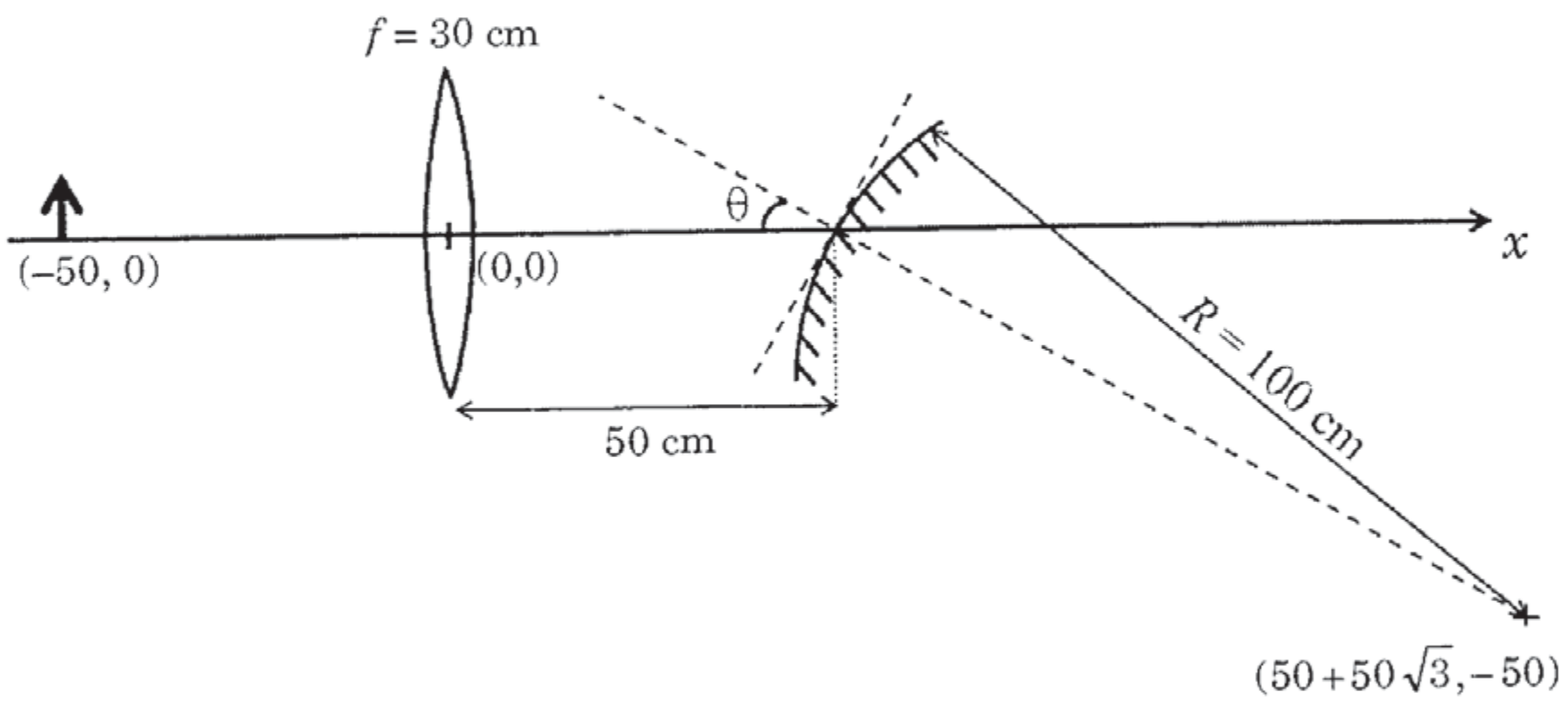
A small object is located to the left of a thin convex lens having focal length . A convex spherical mirror with radius of curvature is positioned to the right of the lens. The mirror is inclined so that its principal axis makes an angle with the optical axis of the lens, as depicted in the figure.
Taking the origin of the coordinate system at the center of the lens, find the coordinates in of the point where the final image is formed.
Options
Step-by-Step Solution
To find the coordinates of the point where the image is formed, we analyze the optical system step-by-step:
Step 1: Image Formation by the Convex Lens
The optical center of the thin convex lens is at the origin .
- Object distance,
- Focal length of the lens,
Using the thin lens formula:
Substituting the given values:
Thus, the first image formed by the lens alone is located at along the principal axis of the lens, giving coordinates .
Step 2: Image Formation by the Tilted Convex Mirror
The pole of the convex mirror is located at .
Since the rays from the lens converge towards , which lies behind the mirror surface, acts as a virtual object for the convex mirror.
- Object distance for the mirror,
- Radius of curvature, Focal length,
Using the mirror formula:
The negative sign indicates that a real image is formed in front of the mirror surface at a distance of from the pole .
Step 3: Determining the Direction and Coordinates of the Final Image
- The principal axis of the mirror (normal at pole ) is inclined downwards at an angle relative to the positive -axis.
- The ray traveling along the principal axis of the lens () strikes the pole at an angle of incidence with respect to the mirror's normal.
- According to the law of reflection, the reflected ray at leaves at an angle above the normal.
- Therefore, the angle made by the reflected ray with the positive -axis is:
The unit vector in the direction of the reflected ray from the pole is:
Since the real image is formed at a distance from along this direction, its position vector is:
Thus, the coordinates of the image are .
Correct Option: C