JEE Challenger
More from Current Electricity

Unknown Resistance and Error in Metre Bridge Experiment

During an experiment with a metre bridge, the galvanometer indicates a null deflection when the jockey is pressed at a mark of 40.0 cm40.0\text{ cm} using a standard resistance of 90 Ω90\ \Omega, as depicted in the figure. The least count of the scale used in the metre bridge is 1 mm1\text{ mm}. The value of the unknown resistance is
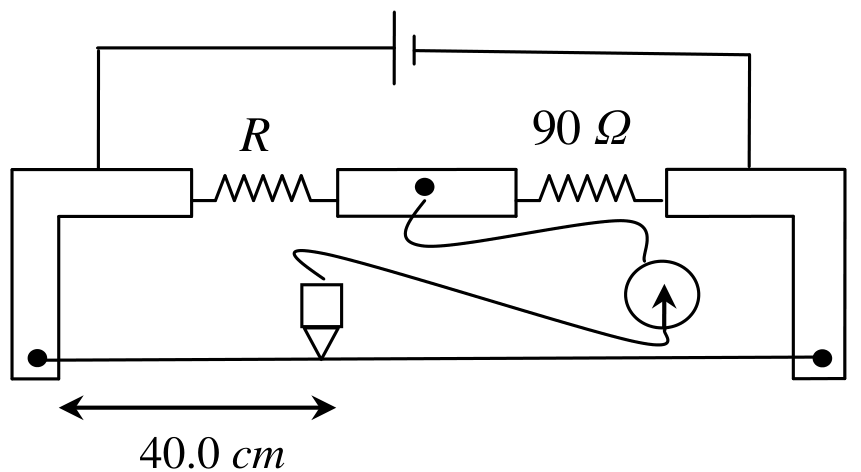
Question Diagram 1

Options

A

60±0.15 Ω60 \pm 0.15\ \Omega

B

135±0.56 Ω135 \pm 0.56\ \Omega

C

60±0.25 Ω60 \pm 0.25\ \Omega

Correct
D

135±0.23 Ω135 \pm 0.23\ \Omega

Step-by-Step Solution

To determine the value of the unknown resistance RR and its absolute error, we use the principle of a balanced Wheatstone bridge (metre bridge).

1. Calculation of the Unknown Resistance RR:

In a metre bridge of total wire length L=100 cmL = 100\text{ cm}, the condition for null deflection is given by: RS=l100−l\frac{R}{S} = \frac{l}{100 - l}

Here:

  • S=90 ΩS = 90\ \Omega (known standard resistance)
  • l=40.0 cml = 40.0\text{ cm} (balancing length from the left end)
  • 100−l=100.0−40.0=60.0 cm100 - l = 100.0 - 40.0 = 60.0\text{ cm}

Substitute these values into the formula: R=S(l100−l)=90×(40.060.0)=90×23=60 ΩR = S \left( \frac{l}{100 - l} \right) = 90 \times \left( \frac{40.0}{60.0} \right) = 90 \times \frac{2}{3} = 60\ \Omega


2. Calculation of the Absolute Error ΔR\Delta R:

Expressing RR in terms of ll: R=Sl100−lR = S \frac{l}{100 - l}

Taking the natural logarithm on both sides: ln⁡R=ln⁡S+ln⁡l−ln⁡(100−l)\ln R = \ln S + \ln l - \ln(100 - l)

Assuming the standard resistance SS has negligible error, differentiating both sides gives the maximum fractional error: ΔRR=Δll+Δ(100−l)100−l\frac{\Delta R}{R} = \frac{\Delta l}{l} + \frac{\Delta(100 - l)}{100 - l}

Since the uncertainty in measuring length at either end using the scale is given by the least count of the scale, Δl=1 mm=0.1 cm\Delta l = 1\text{ mm} = 0.1\text{ cm}: ΔRR=Δll+Δl100−l=Δl(1l+1100−l)=100Δll(100−l)\frac{\Delta R}{R} = \frac{\Delta l}{l} + \frac{\Delta l}{100 - l} = \Delta l \left( \frac{1}{l} + \frac{1}{100 - l} \right) = \frac{100 \Delta l}{l(100 - l)}

Now, solving for ΔR\Delta R: ΔR=R(100Δll(100−l))\Delta R = R \left( \frac{100 \Delta l}{l(100 - l)} \right)

Substituting the known values: ΔR=60×(100×0.140.0×60.0)=60×102400=6002400=0.25 Ω\Delta R = 60 \times \left( \frac{100 \times 0.1}{40.0 \times 60.0} \right) = 60 \times \frac{10}{2400} = \frac{600}{2400} = 0.25\ \Omega


3. Conclusion:

The value of the unknown resistance is: R=60±0.25 ΩR = 60 \pm 0.25\ \Omega

Therefore, the correct option is (C).