Comparison of Electric Field Magnitudes for Dielectric Spheres
Charges , , and are uniformly distributed throughout three dielectric solid spheres 1, 2, and 3 having radii , , and , respectively, as depicted in the figure. If the magnitudes of the electric field at point P located at a distance from the center of spheres 1, 2, and 3 are denoted by , , and respectively, then
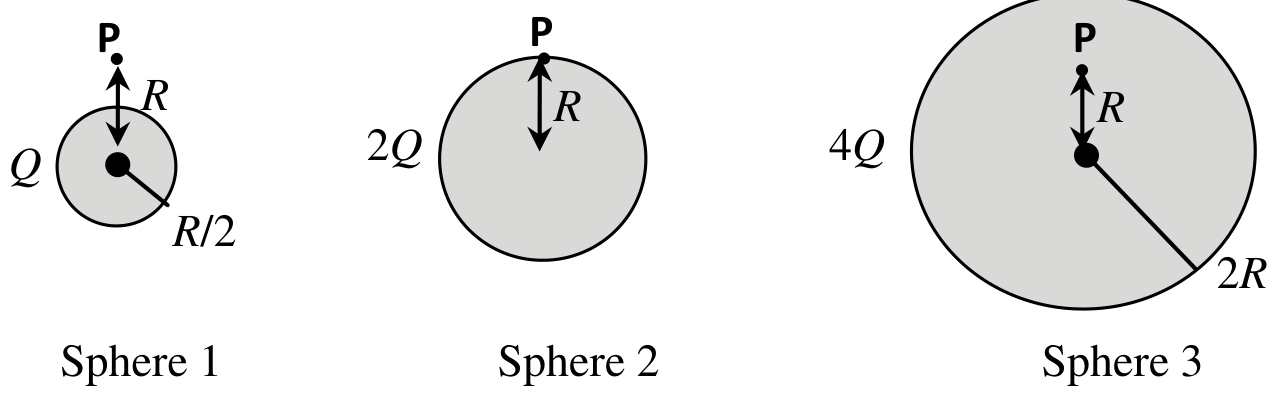
Options
Topics & Concepts
Step-by-Step Solution
To find the magnitudes of the electric fields , , and at a point located at a distance from the centers of the three uniformly charged dielectric solid spheres, we apply Gauss's Law to each sphere.
1. For Sphere 1:
- Total charge:
- Radius:
- Distance of point from the center:
Since , point lies outside the sphere. By Gauss's Law, the electric field outside a spherically symmetric charge distribution acts as if the entire charge were concentrated at the center:
2. For Sphere 2:
- Total charge:
- Radius:
- Distance of point from the center:
Since , point is on the surface of the sphere. The electric field is:
3. For Sphere 3:
- Total charge:
- Radius:
- Distance of point from the center:
Since , point lies inside the sphere. For a uniformly charged solid sphere with charge density , the electric field at an interior distance is given by:
Substituting the given values , , and :
Comparison: Let . Then,
Thus, comparing the magnitudes, we have:
Therefore, the correct option is (C).