Force Exerted by Bead Sliding on Circular Wire
A wire, which passes through the hole of a small bead, is bent into the shape of a quarter of a circle. The wire is fixed vertically to the ground as shown in the figure. The bead is released from rest near the top of the wire at point A and slides along the wire without friction. As the bead travels from point A to point B, the force it exerts on the wire is
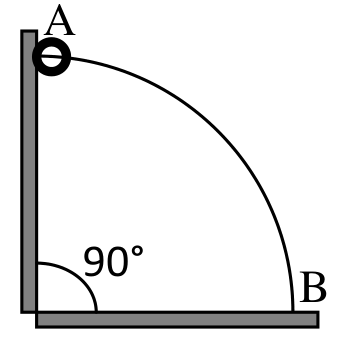
Options
always radially outwards.
always radially inwards.
radially outwards initially and radially inwards later.
radially inwards initially and radially outwards later.
Topics & Concepts
Step-by-Step Solution
To determine the nature of the force exerted by the bead on the circular wire, we analyze the motion of the bead of mass sliding down a vertical frictionless circular wire of radius .
Let the position of the bead be specified by the angle that the radius vector to the bead makes with the vertical line passing through the top point .
-
Velocity of the Bead: Since the bead is released from rest at point (), the vertical distance dropped by the bead after moving through an angle is:
Applying the law of conservation of mechanical energy:
-
Equation of Motion in the Radial Direction: The forces acting on the bead along the radial direction are:
- The component of gravitational force directed radially outwards:
- The normal force exerted by the wire on the bead, , defined radially outwards.
The net force towards the center of the circular arc provides the necessary centripetal acceleration:
Substituting into the equation:
-
Force Exerted by the Bead on the Wire: By Newton's Third Law of Motion, the force exerted by the bead on the wire () is equal and opposite to the normal force exerted by the wire on the bead ().
-
Initially (near point , where and ): This means the wire pushes the bead radially outwards. Therefore, the bead exerts a force on the wire radially inwards.
-
At critical angle : The interaction force between the bead and the wire briefly vanishes.
-
Later (as increases beyond towards point , where ): This means the wire pulls the bead radially inwards. Therefore, the bead exerts a force on the wire radially outwards.
-
Thus, the force exerted by the bead on the wire is radially inwards initially and radially outwards later.
Correct Option: D