Transverse Voltage and Resistance of Semicircular Metallic Strip
A semicircular metallic strip with thickness and electrical resistivity is depicted in the figure. Its inner and outer radii are and , respectively. When a potential difference is maintained across its two end faces, a current passes through it. Additionally, a transverse potential difference arises between the inner and outer boundaries purely owing to kinetic effects of the drifting electrons (neglect any effect of the magnetic field generated by the current). Which of the following statements is/are correct? (The diagram is schematic and not to scale)
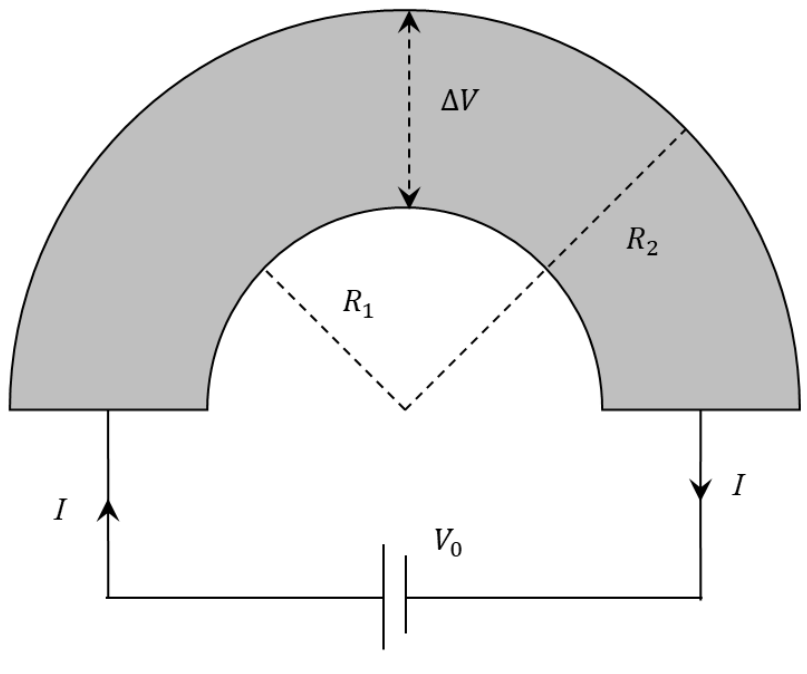
Options
the outer surface is at a higher voltage than the inner surface
the outer surface is at a lower voltage than the inner surface
Topics & Concepts
Step-by-Step Solution
To determine the correct statements, we analyze each property of the semicircular metallic strip step-by-step.
1. Calculation of Current (Option A)
Consider a thin semicircular element of radius and thickness along the radial direction.
- The length of this elemental strip is .
- The cross-sectional area through which the current flows is .
The resistance of this elemental strip is:
Since all such elemental strips are connected in parallel across the potential difference , the net conductance of the entire strip is obtained by integrating the differential conductances :
Therefore, the total current passing through the strip is:
This confirms that Option A is correct.
2. Potential of Inner vs. Outer Surfaces (Options B and C)
The electrons drift along concentric circular paths to form the electric current. For an electron of mass and charge moving with drift velocity along a circle of radius , the required centripetal acceleration is directed radially inward towards the center:
This centripetal acceleration must be provided by a radial electric force :
Since , the radial electric field points radially outward (from to ).
The electric field is related to the electric potential by:
Because , the potential decreases as increases. Consequently, the potential at the outer surface is lower than the potential at the inner surface :
Thus, the outer surface is at a lower voltage than the inner surface. This confirms that Option C is correct and Option B is incorrect.
3. Dependence of Transverse Voltage on Current (Option D)
The tangential electric field at radius is:
According to Ohm's law, the current density is:
Using , the drift velocity of electrons is:
Since (from Option A), we have .
The transverse potential difference between the inner and outer boundaries is:
Since , it follows that . Substituting this into the integral gives:
This confirms that Option D is correct.
Conclusion
The correct options are A, C, and D.