Diffusion Rate and Force Balance of Potassium Permanganate Solution
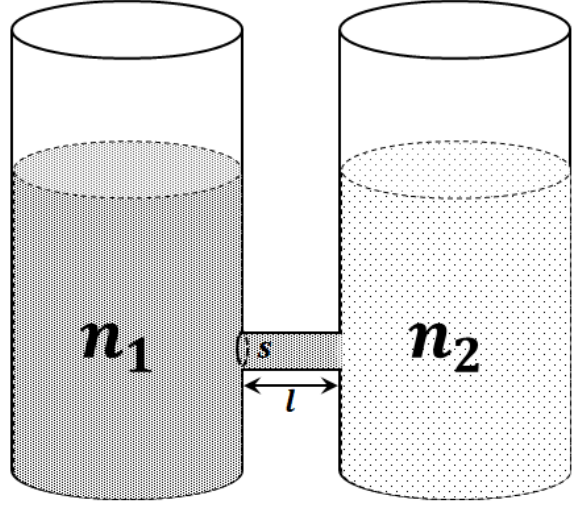
As illustrated schematically in the figure, two vessels contain water solutions (at temperature ) of potassium permanganate () with differing concentrations and () molecules per unit volume, with . When connected by a narrow tube of small length and cross-sectional area , begins to diffuse from the left vessel to the right vessel via the tube. Assume the system of molecules behaves as a dilute ideal gas, with the difference in partial pressure between the two vessels driving the diffusion. The drift speed of each molecule is constrained by a viscous force , where is a constant. Neglecting terms of order , which of the following statements is/are correct? ( represents Boltzmann's constant)
Options
the driving force causing the molecules to pass through the tube is
the balance of forces implies
the total rate of molecules passing through the tube per second is
the rate at which molecules transfer through the tube does not change with time
Topics & Concepts
Step-by-Step Solution
To determine which of the statements are correct, we analyze the system step-by-step using the principles of ideal gas kinetic theory and fluid dynamics applied to dilute solutions.
1. Driving Force (Option A)
The system of molecules behaves as a dilute ideal gas. The partial pressure of the molecules in a region with concentration at temperature is given by:
The partial pressure difference between the two vessels across the connecting tube of cross-sectional area is:
The driving force acting on the fluid within the tube due to this pressure difference is:
Thus, Option A is correct.
2. Force Balance (Option B)
Since , the average concentration of molecules inside the tube can be approximated as .
The volume of the connecting tube is . Therefore, the total number of molecules inside the tube is:
Each molecule experiences a viscous retarding force of magnitude , where is the drift speed. The total retarding force on all molecules in the tube is:
At steady drift motion, the driving force balances the viscous retarding force:
Dividing both sides by :
Thus, Option B is correct.
3. Rate of Molecule Transfer (Option C)
The drift velocity of the molecules can be expressed using the force balance relation from Option B:
The total rate of molecules transferring through the tube per second (flux) is given by:
Substituting the value of :
Thus, Option C is correct.
4. Time Dependence of the Rate (Option D)
As molecules diffuse from the left vessel to the right vessel, the concentration decreases while increases. Consequently, the concentration difference decreases over time.
Since the rate of molecule transfer is directly proportional to :
The transfer rate must decrease exponentially over time as equilibrium is approached. Therefore, it does not remain constant.
Thus, Option D is incorrect.
Conclusion
The correct options are A, B, and C.