JEE Challenger
More from Electric Charges and Fields

Motion of Charged Particle in Uniform Electric Field Projectile

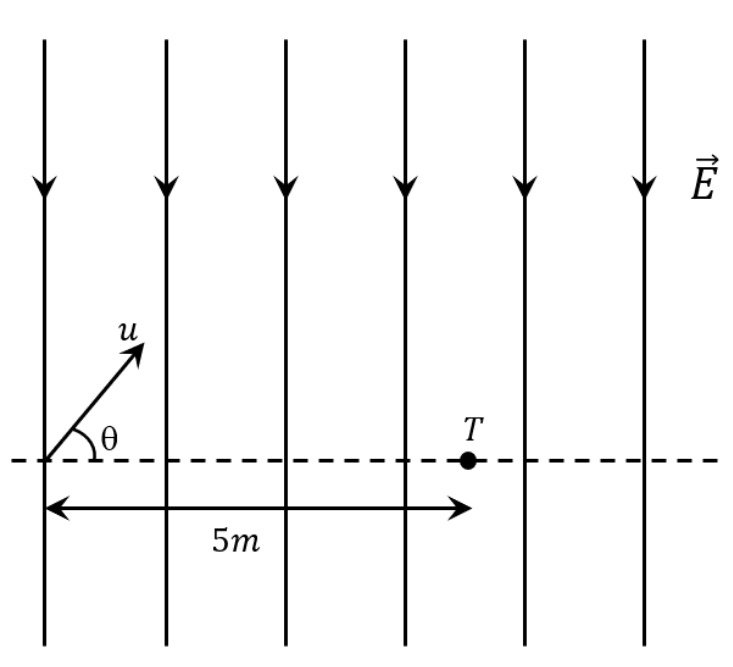
Consider a region with a uniform electric field E⃗=−4003y^ NC−1\vec{E} = -400\sqrt{3}\hat{y} \text{ NC}^{-1}. A particle carrying mass mm and positive charge qq enters this region with a speed u=210×106 ms−1u = 2\sqrt{10} \times 10^6 \text{ ms}^{-1}. The target T is located at a distance of 5 m5\text{ m} along the horizontal line from the point of entry, as depicted in the schematic. Given that qm=1010 C kg−1\frac{q}{m} = 10^{10} \text{ C kg}^{-1}, select the correct option(s):

Question Diagram 1

Options

A

The particle hits target T when projected at an angle of 45∘45^\circ relative to the horizontal.

B

The particle hits target T when projected at an angle of either 30∘30^\circ or 60∘60^\circ relative to the horizontal.

Correct
C

The time taken to reach target T can be 56μs\sqrt{\frac{5}{6}} \mu\text{s} or 52μs\sqrt{\frac{5}{2}} \mu\text{s}.

Correct
D

The time taken to reach target T is 53μs\sqrt{\frac{5}{3}} \mu\text{s}.

Step-by-Step Solution

To determine the correct options, we analyze the motion of the charged particle in the uniform electric field.

1. Acceleration of the Particle

The electric field present in the region is given by: E⃗=−4003y^ NC−1\vec{E} = -400\sqrt{3}\hat{y} \text{ NC}^{-1}

The force acting on the particle of positive charge qq is: F⃗=qE⃗=−4003qy^ N\vec{F} = q\vec{E} = -400\sqrt{3}q\hat{y} \text{ N}

Thus, the acceleration of the particle a⃗\vec{a} is given by: a⃗=qmE⃗=1010×(−4003y^)=−43×1012y^ ms−2\vec{a} = \frac{q}{m}\vec{E} = 10^{10} \times \left(-400\sqrt{3}\hat{y}\right) = -4\sqrt{3} \times 10^{12}\hat{y} \text{ ms}^{-2}

Hence, the components of acceleration are: ax=0a_x = 0 ay=−a=−43×1012 ms−2a_y = -a = -4\sqrt{3} \times 10^{12} \text{ ms}^{-2}

Since the acceleration is purely along the negative yy-direction, the motion of the particle is analogous to standard projectile motion under constant downward acceleration a=43×1012 ms−2a = 4\sqrt{3} \times 10^{12} \text{ ms}^{-2}.


2. Angle of Projection

The particle is projected with an initial speed u=210×106 ms−1u = 2\sqrt{10} \times 10^6 \text{ ms}^{-1} at an angle θ\theta with the horizontal line to hit the target T\text{T} located at a distance R=5 mR = 5\text{ m} on the same horizontal level.

The horizontal range RR of a projectile is given by: R=u2sin⁡2θaR = \frac{u^2 \sin 2\theta}{a}

Substituting the known values into the equation: 5=(210×106)2sin⁡2θ43×10125 = \frac{\left(2\sqrt{10} \times 10^6\right)^2 \sin 2\theta}{4\sqrt{3} \times 10^{12}}

Evaluating u2u^2: u2=4×10×1012=40×1012 m2s−2u^2 = 4 \times 10 \times 10^{12} = 40 \times 10^{12} \text{ m}^2\text{s}^{-2}

Substituting u2u^2: 5=40×1012sin⁡2θ43×10125 = \frac{40 \times 10^{12} \sin 2\theta}{4\sqrt{3} \times 10^{12}} 5=10sin⁡2θ35 = \frac{10 \sin 2\theta}{\sqrt{3}} sin⁡2θ=5310=32\sin 2\theta = \frac{5\sqrt{3}}{10} = \frac{\sqrt{3}}{2}

This gives two possible values for 2θ2\theta: 2θ=60∘or2θ=120∘2\theta = 60^\circ \quad \text{or} \quad 2\theta = 120^\circ

  ⟹  θ=30∘orθ=60∘\implies \theta = 30^\circ \quad \text{or} \quad \theta = 60^\circ

Thus, the particle hits target T when projected at an angle of either 30∘30^\circ or 60∘60^\circ relative to the horizontal. This makes Option (B) correct and Option (A) incorrect.


3. Time of Flight

The time taken by the particle to reach the target T is the time of flight TT, given by: T=2usin⁡θaT = \frac{2u\sin\theta}{a}

  • Case 1: For θ=30∘\theta = 30^\circ T1=2×(210×106)×sin⁡30∘43×1012T_1 = \frac{2 \times \left(2\sqrt{10} \times 10^6\right) \times \sin 30^\circ}{4\sqrt{3} \times 10^{12}} T1=2×(210×106)×1243×1012=210×10643×1012=1023×10−6 sT_1 = \frac{2 \times \left(2\sqrt{10} \times 10^6\right) \times \frac{1}{2}}{4\sqrt{3} \times 10^{12}} = \frac{2\sqrt{10} \times 10^6}{4\sqrt{3} \times 10^{12}} = \frac{\sqrt{10}}{2\sqrt{3}} \times 10^{-6} \text{ s} T1=1012μs=56μsT_1 = \sqrt{\frac{10}{12}} \mu\text{s} = \sqrt{\frac{5}{6}} \mu\text{s}

  • Case 2: For θ=60∘\theta = 60^\circ T2=2×(210×106)×sin⁡60∘43×1012T_2 = \frac{2 \times \left(2\sqrt{10} \times 10^6\right) \times \sin 60^\circ}{4\sqrt{3} \times 10^{12}} T2=2×(210×106)×3243×1012=230×10643×1012=102×10−6 sT_2 = \frac{2 \times \left(2\sqrt{10} \times 10^6\right) \times \frac{\sqrt{3}}{2}}{4\sqrt{3} \times 10^{12}} = \frac{2\sqrt{30} \times 10^6}{4\sqrt{3} \times 10^{12}} = \frac{\sqrt{10}}{2} \times 10^{-6} \text{ s} T2=104μs=52μsT_2 = \sqrt{\frac{10}{4}} \mu\text{s} = \sqrt{\frac{5}{2}} \mu\text{s}

Thus, the time taken to reach target T can be 56μs\sqrt{\frac{5}{6}} \mu\text{s} or 52μs\sqrt{\frac{5}{2}} \mu\text{s}. This makes Option (C) correct and Option (D) incorrect.

Conclusion

The correct options are (B) and (C).