JEE Challenger
More from Electrostatic Potential and Capacitance

Total Energy Dissipated in Multi Step RC Charging Process

Comprehension Passage

PARAGRAPH 1

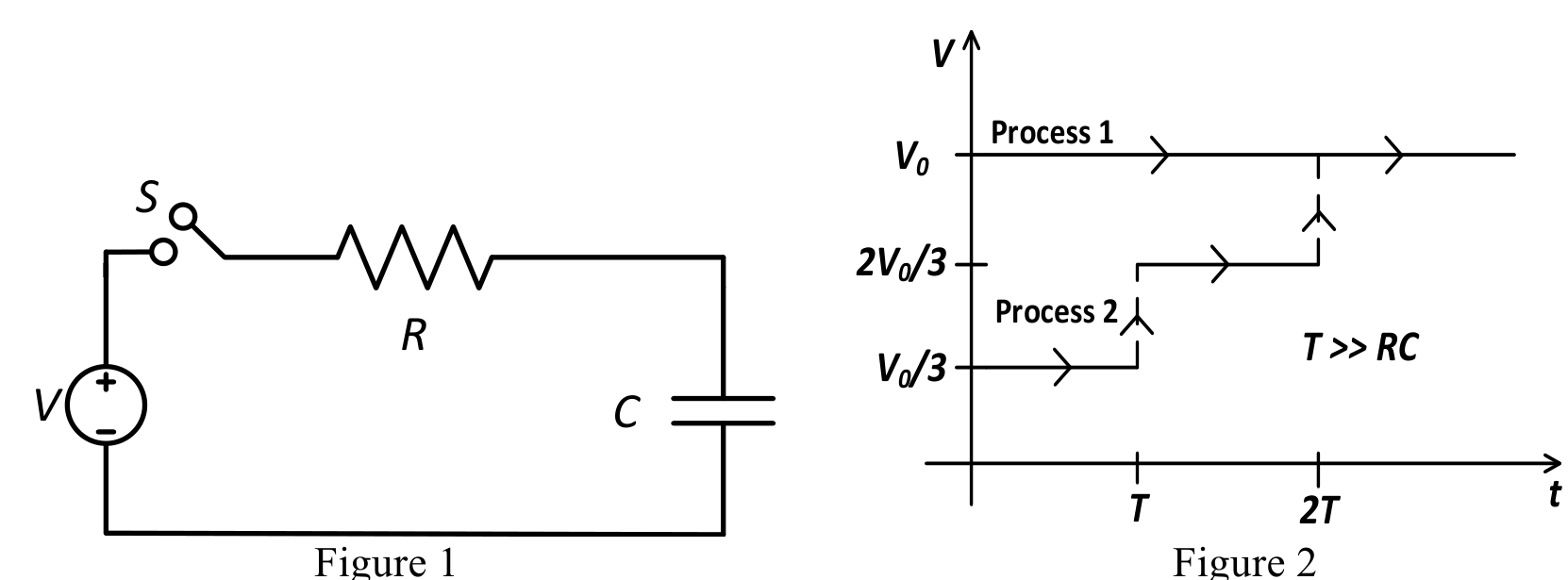
Consider a simple RCRC circuit as shown in Figure 1.

Process 1: In the circuit the switch SS is closed at t=0t = 0 and the capacitor is fully charged to voltage V0V_0 (i.e., charging continues for time T≫RCT \gg RC). In the process some dissipation (EDE_D) occurs across the resistance RR. The amount of energy finally stored in the fully charged capacitor is ECE_C.

Process 2: In a different process the voltage is first set to V03\frac{V_0}{3} and maintained for a charging time T≫RCT \gg RC. Then the voltage is raised to 2V03\frac{2V_0}{3} without discharging the capacitor and again maintained for a time T≫RCT \gg RC. The process is repeated one more time by raising the voltage to V0V_0 and the capacitor is charged to the same final voltage V0V_0 as in Process 1.

These two processes are depicted in Figure 2.

For Process 2, the total energy EDE_D dissipated through the resistor is:

Question Diagram 1

Options

A

ED=12CV02E_D = \frac{1}{2} C V_0^2

B

ED=3(12CV02)E_D = 3 \left( \frac{1}{2} C V_0^2 \right)

C

ED=13(12CV02)E_D = \frac{1}{3} \left( \frac{1}{2} C V_0^2 \right)

Correct
D

ED=3CV02E_D = 3 C V_0^2

Step-by-Step Solution

To calculate the total energy dissipated through the resistor (EDE_D) in Process 2, we evaluate the heat dissipated across the resistor in each step of the multi-step charging process.

General Formula for Dissipative Heat in an RCRC Step

When a capacitor of capacitance CC, initially charged to potential ViV_i, is connected to a source maintaining a constant potential VfV_f for a time duration T≫RCT \gg RC, the charge added to the capacitor is: Δq=C(Vf−Vi)\Delta q = C(V_f - V_i)

The work done by the voltage source is: Wsource=Vf⋅Δq=CVf(Vf−Vi)W_{\text{source}} = V_f \cdot \Delta q = C V_f (V_f - V_i)

The change in stored electrostatic potential energy of the capacitor is: ΔU=12CVf2−12CVi2=12C(Vf−Vi)(Vf+Vi)\Delta U = \frac{1}{2} C V_f^2 - \frac{1}{2} C V_i^2 = \frac{1}{2} C (V_f - V_i)(V_f + V_i)

By the law of conservation of energy, the heat energy dissipated through the resistor HH during this step is: H=Wsource−ΔUH = W_{\text{source}} - \Delta U H=CVf(Vf−Vi)−12C(Vf−Vi)(Vf+Vi)H = C V_f (V_f - V_i) - \frac{1}{2} C (V_f - V_i)(V_f + V_i) H=12C(Vf−Vi)[2Vf−(Vf+Vi)]H = \frac{1}{2} C (V_f - V_i) \left[ 2V_f - (V_f + V_i) \right] H=12C(Vf−Vi)2H = \frac{1}{2} C (V_f - V_i)^2


Step-by-Step Dissipation in Process 2

  1. Step 1: Voltage increases from Vi=0V_i = 0 to Vf=V03V_f = \frac{V_0}{3} H1=12C(V03−0)2=12C(V03)2H_1 = \frac{1}{2} C \left(\frac{V_0}{3} - 0\right)^2 = \frac{1}{2} C \left(\frac{V_0}{3}\right)^2

  2. Step 2: Voltage increases from Vi=V03V_i = \frac{V_0}{3} to Vf=2V03V_f = \frac{2V_0}{3} H2=12C(2V03−V03)2=12C(V03)2H_2 = \frac{1}{2} C \left(\frac{2V_0}{3} - \frac{V_0}{3}\right)^2 = \frac{1}{2} C \left(\frac{V_0}{3}\right)^2

  3. Step 3: Voltage increases from Vi=2V03V_i = \frac{2V_0}{3} to Vf=V0V_f = V_0 H3=12C(V0−2V03)2=12C(V03)2H_3 = \frac{1}{2} C \left(V_0 - \frac{2V_0}{3}\right)^2 = \frac{1}{2} C \left(\frac{V_0}{3}\right)^2


Total Energy Dissipated (EDE_D)

Summing the energy dissipated across all three steps: ED=H1+H2+H3E_D = H_1 + H_2 + H_3 ED=3×[12C(V03)2]E_D = 3 \times \left[ \frac{1}{2} C \left(\frac{V_0}{3}\right)^2 \right] ED=3×19(12CV02)E_D = 3 \times \frac{1}{9} \left( \frac{1}{2} C V_0^2 \right) ED=13(12CV02)E_D = \frac{1}{3} \left( \frac{1}{2} C V_0^2 \right)

Thus, the correct option is C.