Calculate Total Kinetic Energy of Ring Rolling on Rotating Finger
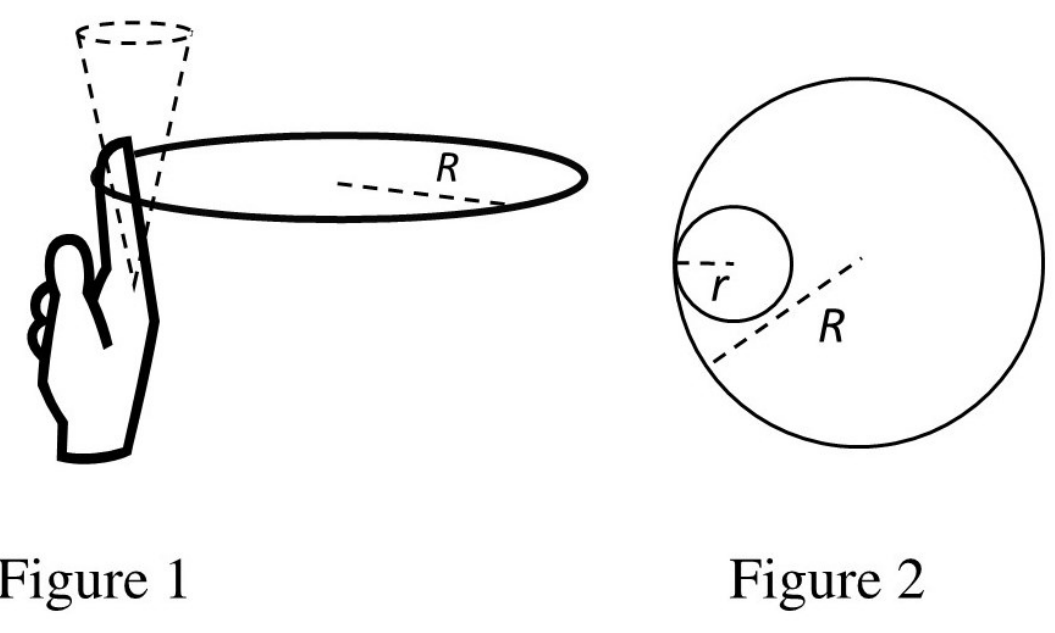
Consider a circular ring of mass and radius twirled near the tip of a finger as illustrated. During this motion, the finger constantly maintains contact with the inner rim of the ring. The finger traces out the surface of a cone. The contact point between the ring and the finger traces a circular path of radius . The finger rotates with an angular speed . The ring performs rolling without slipping on the outer boundary of the smaller circle described by the contact point. The coefficient of friction between the ring and finger is , and the acceleration due to gravity is .
Determine the total kinetic energy of the rotating ring.
This question was dropped / full marks were awarded to all candidates in the official answer key by the exam conducting body due to an ambiguity or error in the question or options.
Options
Topics & Concepts
Step-by-Step Solution
To determine the total kinetic energy of the rotating ring, we analyze its motion by separating it into translation of the center of mass and rotation about the center of mass.
1. Motion of the Center of Mass
The ring has mass and radius . The point of contact between the inner rim of the ring and the finger moves in a circular path of radius .
The distance from the central axis (origin) to the center of mass () of the ring is:
Since the line joining the origin to the center of the ring revolves with an angular velocity , the speed of the center of mass is:
2. Translational Kinetic Energy
The translational kinetic energy of the ring is given by:
3. Rotational Motion and Condition for No Slipping
Let be the spin angular velocity of the ring about its own center of mass.
For rolling without slipping on the surface, the instantaneous velocity of the point of contact on the ring relative to the center of rotation must be zero:
Taking magnitudes along the tangential direction:
Substitute :
4. Rotational Kinetic Energy
, The moment of inertia of a circular ring about its central axis passing through its center of mass is:
The rotational kinetic energy about the center of mass is:
5. Total Kinetic Energy
The total kinetic energy of the ring is the sum of its translational and rotational kinetic energies:
Thus, the total kinetic energy of the rotating ring is , which corresponds to Option [C].