Energy Stored and Dissipated in Single Step RC Charging Process
PARAGRAPH 1
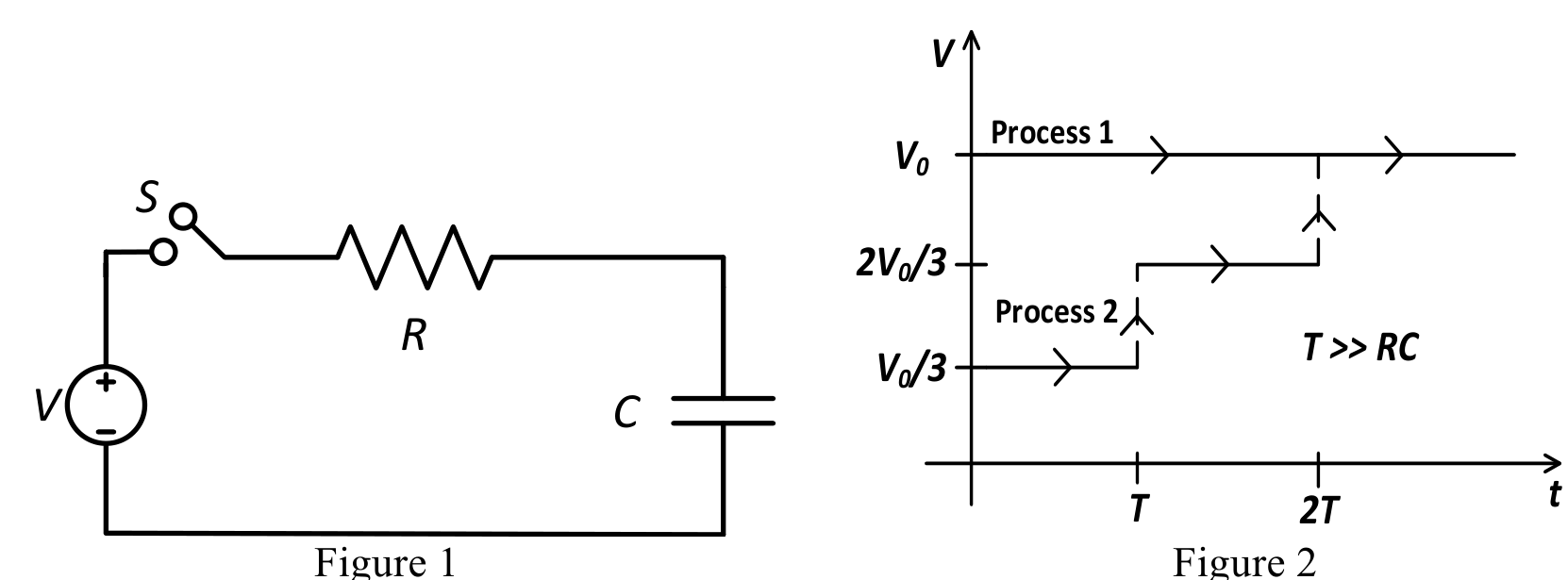
Consider a simple circuit as shown in Figure 1.
Process 1: In the circuit the switch is closed at and the capacitor is fully charged to voltage (i.e., charging continues for time ). In the process some dissipation () occurs across the resistance . The amount of energy finally stored in the fully charged capacitor is .
Process 2: In a different process the voltage is first set to and maintained for a charging time . Then the voltage is raised to without discharging the capacitor and again maintained for a time . The process is repeated one more time by raising the voltage to and the capacitor is charged to the same final voltage as in Process 1.
These two processes are depicted in Figure 2.
For Process 1, the relationship between the energy stored in the capacitor and the heat energy dissipated across the resistor is given by:
Options
Topics & Concepts
Step-by-Step Solution
In Process 1, a capacitor of capacitance is charged by a battery of constant voltage from an initial uncharged state () to a fully charged state ().
-
Work Done by the Battery (): The total charge that flows through the battery during the charging process is: The work done by the battery maintained at constant potential is given by:
-
Energy Stored in the Capacitor (): The electrostatic potential energy stored in the capacitor when fully charged to potential is:
-
Energy Dissipated across the Resistor (): By the law of conservation of energy, the difference between the total energy supplied by the battery and the energy stored in the capacitor is dissipated as heat across the resistor:
-
Relationship between and : Comparing the expressions for and :
This corresponds to Option A.