Thermodynamic Cyclic Process of Ideal Gas on Volume-Temperature Diagram
One mole of an ideal gas in initial state A undergoes a cyclic process ABCA, as shown in the figure. Its pressure at A is . Choose the correct option(s) from the following
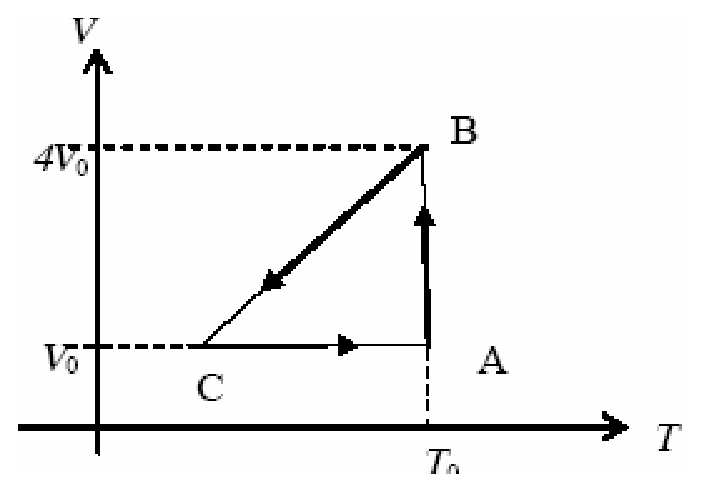
Options
Internal energies at A and B are the same
Work done by the gas in process AB is
Pressure at C is
Temperature at C is
Topics & Concepts
Step-by-Step Solution
To determine the correct option(s), we analyze the cyclic process on the given diagram for of an ideal gas.
1. Analysis of States and Processes
-
State A:
The temperature and volume at state A are and .
From the ideal gas equation (), the pressure at A is given by:
-
Process AB:
The path is a vertical line at constant temperature .
Thus, and . Process is an isothermal expansion. -
Process BC:
The path lies on a straight line passing through the origin and point B . -
Process CA:
The path is a horizontal line at constant volume . Thus, .
2. Verification of Options
-
Option A: Internal energies at A and B are the same
The internal energy of an ideal gas depends only on its temperature:
Since , we have .Option A is correct.
-
Option B: Work done by the gas in process AB is
Since process is isothermal at temperature , the work done by the gas is:
Substituting , , and :
Since :
Option B is correct.
-
Option D: Temperature at C is
Since the line passes through the origin in the plane, its relation is given by , where is a constant slope.
Using state B :
For state C :
Option D is correct.
-
Option C: Pressure at C is
For process , since , the ratio is constant.
From the ideal gas equation , a constant ratio of implies that pressure remains constant along line (an isobaric process).
Therefore, .
The pressure at state B is:
Hence, .Option C is correct.
Conclusion
All options A, B, C, and D are correct.