Condition on Total Energy for Periodic Motion in Potential Well
When a particle of mass moves on the -axis in a potential of the form , it performs simple harmonic motion. The corresponding time period is proportional to , as can be seen easily using dimensional analysis. However, the motion of a particle can be periodic even when its potential energy increases on both sides of in a way different from and its total energy is such that the particle does not escape to infinity. Consider a particle of mass moving on the -axis. Its potential energy is () for near the origin and becomes a constant equal to for (see figure).
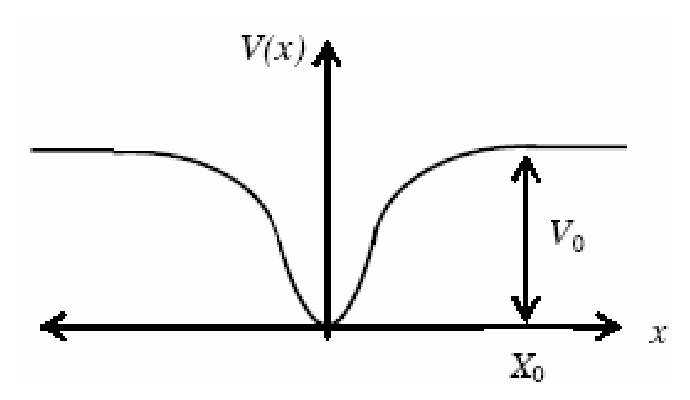
If the total energy of the particle is , it will perform periodic motion only if
This question was dropped / full marks were awarded to all candidates in the official answer key by the exam conducting body due to an ambiguity or error in the question or options.
Options
Topics & Concepts
Step-by-Step Solution
To determine the condition on the total energy for the particle to perform periodic motion, we analyze the potential energy curve :
-
Minimum Potential Energy:
Near the origin, the potential energy is given by:
The minimum potential energy occurs at :
The kinetic energy of the particle is given by:
For the particle to move (i.e., not remain permanently at rest at ), its total energy must be strictly greater than the minimum potential energy:
-
Bound State Condition (Confinement):
For , the potential energy becomes a constant value .- If , the particle has sufficient energy to overcome the potential well and escape to infinity (). Such motion is unbounded and therefore non-periodic.
- If , the particle encounters classical turning points at (where and ). The particle is trapped within the potential well, oscillating back and forth between and , which constitutes periodic motion.
Combining both conditions:
-
For periodic motion to occur, the total energy must satisfy:
This corresponds directly to Option C. -
Since the question asks "will perform periodic motion only if", it specifies a necessary condition (). Since implies , the condition is also a strictly necessary condition, making Option B valid as well.
Therefore, the correct options are B and C.