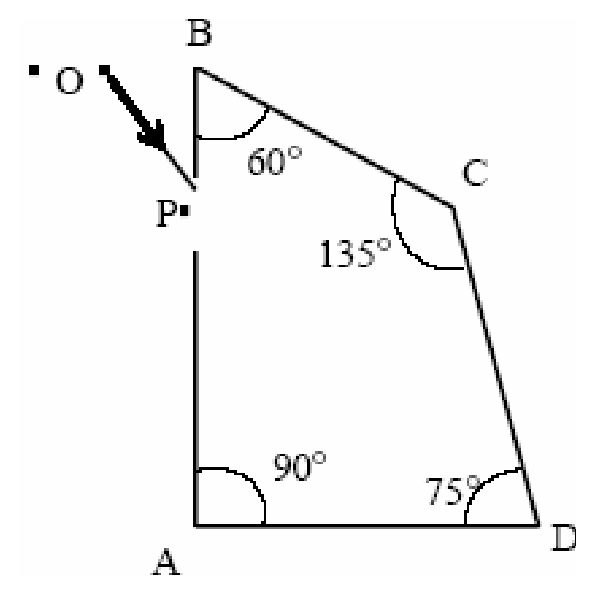
Monochromatic Light Ray Incident on Quadrilateral Prism
A ray OP of monochromatic light is incident on the face AB of prism ABCD near vertex B at an incident angle of 60∘ (see figure). If the refractive index of the material of the prism is 3, which of the following is (are) correct ?
Options
A
The ray gets totally internally reflected at face CD
Correct
B
The ray comes out through face AD
Correct
C
The angle between the incident ray and the emergent ray is 90∘
Correct
D
The angle between the incident ray and the emergent ray is 120∘
To determine the correct options, we analyze the path of the monochromatic light ray step-by-step as it traverses the quadrilateral prism ABCD.
1. Refraction at Face AB
From the given geometry of the prism:
∠A=90∘
∠B=60∘
∠C=135∘
∠D=75∘
Refractive index of the prism, μ=3.
Let face AD lie along the positive x-axis and face AB along the positive y-axis. The normal to face AB is parallel to the x-axis.
The incident ray OP hits face AB at an angle of incidence i1=60∘. By Snell's Law at face AB: 1⋅sin(i1)=μsin(r1) sin(60∘)=3sin(r1) 23=3sin(r1)⟹sin(r1)=21⟹r1=30∘
The unit vector in the direction of the incident ray is: v^inc=cos(60∘)i^−sin(60∘)j^=21i^−23j^
The unit vector of the refracted ray inside the prism is: v^ref1=cos(30∘)i^−sin(30∘)j^=23i^−21j^
2. Propagation towards Face CD
The direction of face BC relative to face AB (which is along +j^) makes an angle of 60∘ downwards, given by the unit vector: u^BC=sin(60∘)i^−cos(60∘)j^=23i^−21j^
Since v^ref1=u^BC, the refracted ray travels parallel to face BC. Because point P is near vertex B, the ray does not intersect face BC and directly reaches face CD.
3. Total Internal Reflection at Face CD
The angle of line CD relative to the x-axis is −75∘. Since the ray travels at an angle of −30∘ with the x-axis, the angle between the ray and face CD is: θ=∣−30∘−(−75∘)∣=45∘
Thus, the angle of incidence at face CD is: iCD=90∘−45∘=45∘
The critical angle θc for the prism-air interface is given by: sin(θc)=μ1=31≈0.577
Since sin(iCD)=sin(45∘)=21≈0.707>sin(θc), we have iCD>θc.
Therefore, the ray undergoes Total Internal Reflection (TIR) at face CD (Option A is correct).
4. Reflection and Emergence at Face AD
The angle of reflection at face CD is rCD=45∘. The reflected ray undergoes a total direction shift of 2×45∘=90∘ downwards/inwards.
The direction vector of the reflected ray inside the prism is: v^refl=cos(−120∘)i^+sin(−120∘)j^=−21i^−23j^
This reflected ray travels towards face AD (which lies on y=0). Hence, the ray comes out through face AD (Option B is correct).
The normal to face AD is along −j^. The angle of incidence at face AD is: cos(iAD)=v^refl⋅(−j^)=23⟹iAD=30∘
By Snell's Law at face AD: μsin(iAD)=1⋅sin(e) 3sin(30∘)=sin(e)⟹sin(e)=23⟹e=60∘
The direction unit vector of the emergent ray in air is: v^emergent=−sin(60∘)i^−cos(60∘)j^=−23i^−21j^
5. Angle Between Incident and Emergent Rays
Taking the scalar product of the incident ray vector v^inc and the emergent ray vector v^emergent: v^inc⋅v^emergent=(21)(−23)+(−23)(−21)=0
Since the dot product is zero, the angle between the incident ray and the emergent ray is 90∘ (Option C is correct).