Temperature of Rising Gas Bubble in Liquid Column
Paragraph for Question Nos. 38 to 40
A small spherical monoatomic ideal gas bubble is trapped inside a liquid of density (see figure). Assume that the bubble does not exchange any heat with the liquid. The bubble contains moles of gas. The temperature of the gas when the bubble is at the bottom is , the height of the liquid is and the atmospheric pressure is (Neglect surface tension).
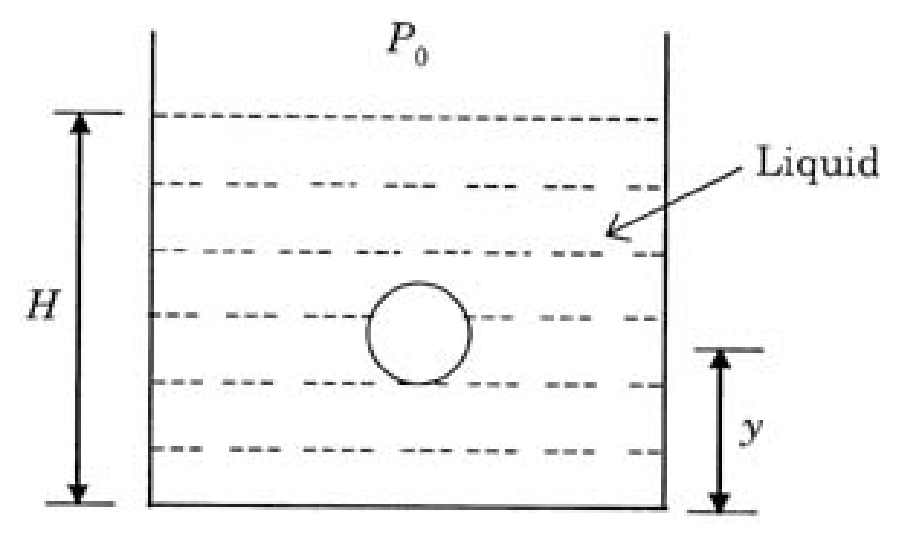
When the gas bubble is at a height from the bottom, its temperature is
Options
Topics & Concepts
Step-by-Step Solution
To find the temperature of the gas bubble as a function of height from the bottom of the container, we analyze the thermodynamics of the process:
-
Pressure of the Bubble:
Neglecting surface tension, the pressure inside the bubble is equal to the hydrostatic pressure of the liquid at that depth plus the atmospheric pressure .- At the bottom of the liquid column (depth ), the pressure is:
The temperature of the gas at this position is given as . - At a height from the bottom, the depth of the bubble below the free liquid surface is . Hence, the pressure inside the bubble is:
- At the bottom of the liquid column (depth ), the pressure is:
-
Thermodynamic Process:
Since the bubble does not exchange any heat with the surrounding liquid, the expansion of the gas as it rises is an adiabatic process.For an adiabatic process involving an ideal gas:
-
Calculation of Temperature:
For a monoatomic ideal gas, the adiabatic index is .
The exponent is:
Applying the relation between the initial state (at the bottom) and the state at height :
Substituting the pressures:
Therefore, the correct option is B.