Forces Acting on Upward Moving Bubble in Liquid
Paragraph for Question Nos. 38 to 40
A small spherical monoatomic ideal gas bubble is trapped inside a liquid of density (see figure). Assume that the bubble does not exchange any heat with the liquid. The bubble contains moles of gas. The temperature of the gas when the bubble is at the bottom is , the height of the liquid is and the atmospheric pressure is (Neglect surface tension).
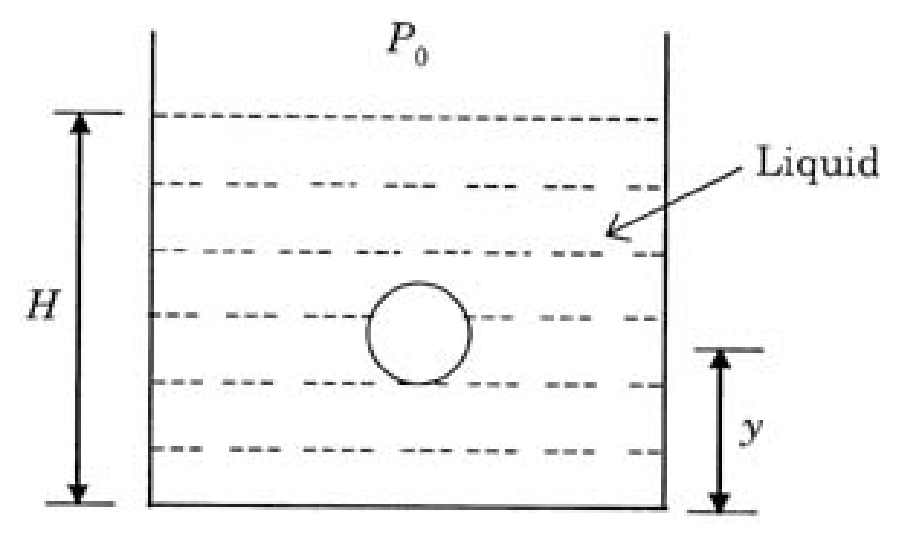
As the bubble moves upwards, besides the buoyancy force the following forces are acting on it
Options
Only the force of gravity
The force due to gravity and the force due to the pressure of the liquid
The force due to gravity, the force due to the pressure of the liquid and the force due to viscosity of the liquid
The force due to gravity and the force due to viscosity of the liquid
Topics & Concepts
Step-by-Step Solution
To determine the forces acting on the bubble as it moves upwards through the liquid, let us analyze the physical interactions between the bubble and its surroundings:
-
Force due to Liquid Pressure (Buoyancy Force):
The pressure of the surrounding liquid acts perpendicular to every element of the bubble's surface. The net force resulting from the integration of this hydrostatic pressure over the entire closed surface of the bubble is, by definition, the buoyant force ():
Since the question asks for the forces acting on the bubble besides the buoyancy force, including the "force due to the pressure of the liquid" would be redundant (double-counting the same physical interaction). -
Force of Gravity:
The gas inside the bubble has mass , where is the molar mass of the gas. Hence, it experiences a downward gravitational force:
-
Force due to Viscosity of the Liquid:
As the bubble moves upwards through the fluid with a relative velocity , the surrounding liquid exerts a resistive viscous drag force on the bubble opposing its motion (acting downwards):
(or more generally, a hydrodynamic viscous force).
Therefore, besides the buoyancy force, the forces acting on the upward-moving bubble are:
- The force due to gravity, and
- The force due to the viscosity of the liquid.
Hence, the correct option is (D).