JEE Challenger
More from Mechanical Properties of Fluids

Buoyancy Force Acting on a Gas Bubble

Comprehension Passage

Paragraph for Question Nos. 38 to 40

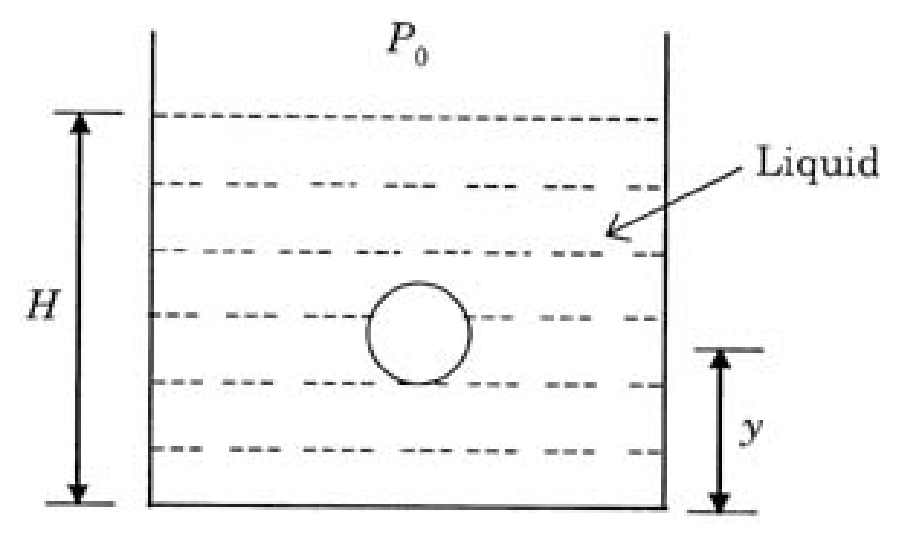
A small spherical monoatomic ideal gas bubble (γ=53)\left(\gamma = \frac{5}{3}\right) is trapped inside a liquid of density ρl\rho_l (see figure). Assume that the bubble does not exchange any heat with the liquid. The bubble contains nn moles of gas. The temperature of the gas when the bubble is at the bottom is T0T_0, the height of the liquid is HH and the atmospheric pressure is P0P_0 (Neglect surface tension).

Passage Diagram 0

The buoyancy force acting on the gas bubble is (Assume RR is the universal gas constant)

Options

A

ρlnRgT0(P0+ρlgH)2/5(P0+ρlgy)7/5\rho_l n R g T_0 \frac{(P_0 + \rho_l g H)^{2/5}}{(P_0 + \rho_l g y)^{7/5}}

B

ρlnRgT0(P0+ρlgH)2/5[P0+ρlg(H−y)]3/5\frac{\rho_l n R g T_0}{(P_0 + \rho_l g H)^{2/5} [P_0 + \rho_l g (H - y)]^{3/5}}

Correct
C

ρlnRgT0(P0+ρlgH)3/5(P0+ρlgy)8/5\rho_l n R g T_0 \frac{(P_0 + \rho_l g H)^{3/5}}{(P_0 + \rho_l g y)^{8/5}}

D

ρlnRgT0(P0+ρlgH)3/5[P0+ρlg(H−y)]2/5\frac{\rho_l n R g T_0}{(P_0 + \rho_l g H)^{3/5} [P_0 + \rho_l g (H - y)]^{2/5}}

Step-by-Step Solution

To determine the buoyancy force acting on the gas bubble, we consider the thermodynamics of the rising bubble:

  1. Pressure of the Bubble:
    Let HH be the depth of the liquid column and yy be the vertical height of the bubble measured from the bottom of the container.
    The depth of the bubble below the free surface of the liquid is h=H−yh = H - y.
    The pressure PP inside the bubble at height yy is equal to the hydrostatic pressure at that depth:
    P=P0+ρlg(H−y)P = P_0 + \rho_l g (H - y)
    At the bottom (y=0y = 0), the initial pressure is:
    Pbottom=P0+ρlgHP_{\text{bottom}} = P_0 + \rho_l g H

  2. Adiabatic Expansion of the Gas:
    The gas inside the bubble consists of nn moles of a monoatomic ideal gas with an adiabatic index γ=53\gamma = \frac{5}{3}.
    Since the expansion is adiabatic, the temperature TT and pressure PP are related by:
    P1−γTγ=constant  ⟹  T∝Pγ−1γP^{1-\gamma} T^\gamma = \text{constant} \implies T \propto P^{\frac{\gamma - 1}{\gamma}}
    Substituting γ=53\gamma = \frac{5}{3}:
    γ−1γ=53−153=25\frac{\gamma - 1}{\gamma} = \frac{\frac{5}{3} - 1}{\frac{5}{3}} = \frac{2}{5}
    Given that the temperature of the gas at the bottom is T0T_0, the temperature at height yy is:
    T=T0(PPbottom)2/5=T0[P0+ρlg(H−y)P0+ρlgH]2/5T = T_0 \left( \frac{P}{P_{\text{bottom}}} \right)^{2/5} = T_0 \left[ \frac{P_0 + \rho_l g (H - y)}{P_0 + \rho_l g H} \right]^{2/5}

  3. Volume of the Bubble:
    Using the ideal gas equation PV=nRTP V = n R T, the volume VV of the bubble at height yy is:
    V=nRTP=nRT0P(PPbottom)2/5=nRT0Pbottom2/5P3/5V = \frac{n R T}{P} = \frac{n R T_0}{P} \left( \frac{P}{P_{\text{bottom}}} \right)^{2/5} = \frac{n R T_0}{P_{\text{bottom}}^{2/5} P^{3/5}}
    Substituting the expressions for PbottomP_{\text{bottom}} and PP:
    V=nRT0(P0+ρlgH)2/5[P0+ρlg(H−y)]3/5V = \frac{n R T_0}{(P_0 + \rho_l g H)^{2/5} [P_0 + \rho_l g (H - y)]^{3/5}}

  4. Buoyancy Force:
    According to Archimedes' principle, the buoyant force FBF_B exerted on the bubble by the liquid of density ρl\rho_l is:
    FB=ρlVg=ρlnRgT0(P0+ρlgH)2/5[P0+ρlg(H−y)]3/5F_B = \rho_l V g = \frac{\rho_l n R g T_0}{(P_0 + \rho_l g H)^{2/5} [P_0 + \rho_l g (H - y)]^{3/5}}

Therefore, the correct option is (B).