JEE Challenger
More from Equilibrium

Temperature Dependence of Equilibrium Constant and Thermodynamic Functions

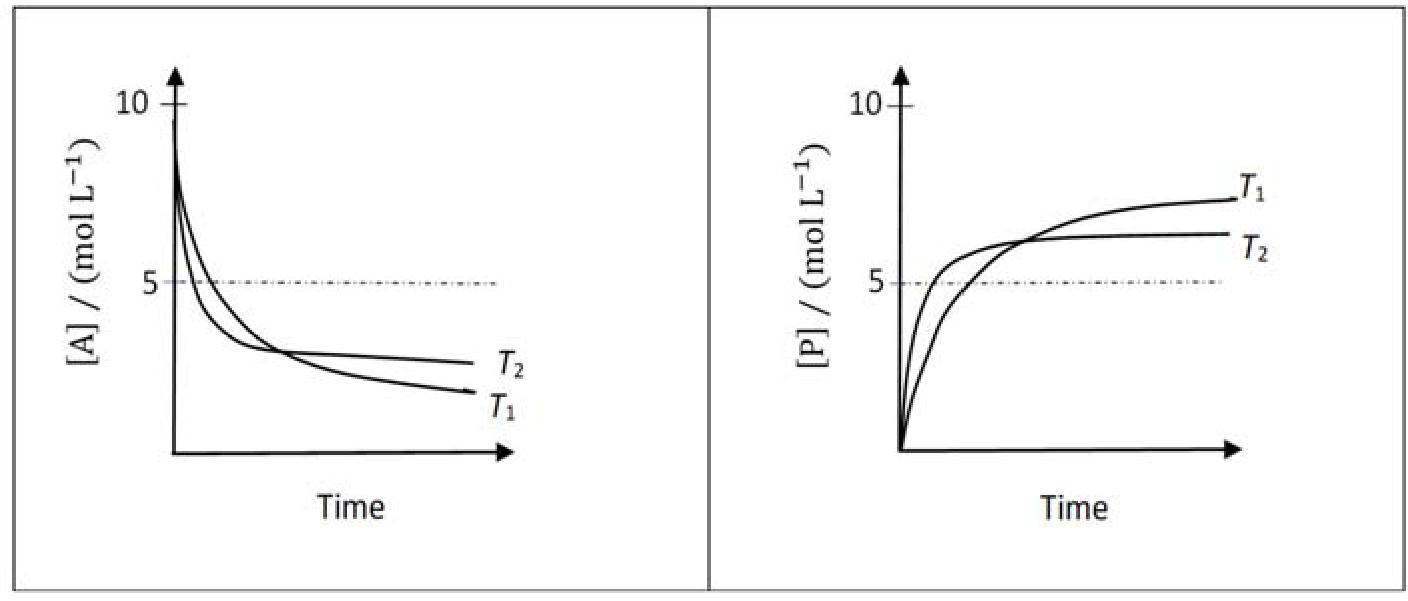
For a chemical transformation A⇌P\text{A} \rightleftharpoons \text{P}, the variation of [A][\text{A}] and [P][\text{P}] over time at temperatures T1T_1 and T2T_2 is shown in the graphs.

Given that T2>T1T_2 > T_1, choose the correct assertion(s). (Assume ΔH⊖\Delta H^{\ominus} and ΔS⊖\Delta S^{\ominus} do not vary with temperature, and the ratio of ln⁡K\ln K at T1T_1 to ln⁡K\ln K at T2T_2 is greater than T2/T1T_2/T_1. The symbols H,S,GH, S, G, and KK represent enthalpy, entropy, Gibbs free energy, and equilibrium constant, respectively.)

Question Diagram 1

Options

A

ΔH⊖<0,ΔS⊖<0\Delta H^{\ominus} < 0, \Delta S^{\ominus} < 0

Correct
B

ΔG⊖<0,ΔH⊖>0\Delta G^{\ominus} < 0, \Delta H^{\ominus} > 0

C

ΔG⊖<0,ΔS⊖<0\Delta G^{\ominus} < 0, \Delta S^{\ominus} < 0

Correct
D

ΔG⊖<0,ΔS⊖>0\Delta G^{\ominus} < 0, \Delta S^{\ominus} > 0

Step-by-Step Solution

To determine the correct options, let us analyze the given reaction A⇌P\text{A} \rightleftharpoons \text{P} step-by-step using thermodynamic principles and the provided graphs.

1. Determination of ΔG⊖\Delta G^{\ominus} and Equilibrium Constant (KK)

From the given graphs for the concentration of A\text{A} and P\text{P} over time:

  • Initial concentration of A\text{A} at t=0t = 0 is 10 mol L−110\text{ mol L}^{-1} and [P]=0 mol L−1[\text{P}] = 0\text{ mol L}^{-1}.
  • At equilibrium for both temperatures T1T_1 and T2T_2: [P]eq>5 mol L−1and[A]eq<5 mol L−1[\text{P}]_{\text{eq}} > 5\text{ mol L}^{-1} \quad \text{and} \quad [\text{A}]_{\text{eq}} < 5\text{ mol L}^{-1}
  • Therefore, at both temperatures T1T_1 and T2T_2: K=[P]eq[A]eq>1K = \frac{[\text{P}]_{\text{eq}}}{[\text{A}]_{\text{eq}}} > 1
  • Since K>1K > 1, it follows that: ln⁡K>0\ln K > 0
  • Using the relation for standard Gibbs free energy change: ΔG⊖=−RTln⁡K\Delta G^{\ominus} = -RT \ln K Since R>0R > 0, T>0T > 0, and ln⁡K>0\ln K > 0, we get: ΔG⊖<0\Delta G^{\ominus} < 0

2. Determination of ΔH⊖\Delta H^{\ominus}

Comparing the equilibrium concentrations at temperatures T1T_1 and T2T_2:

  • [P]eq,T1>[P]eq,T2[\text{P}]_{\text{eq}, T_1} > [\text{P}]_{\text{eq}, T_2}
  • Consequently, K(T1)>K(T2)K(T_1) > K(T_2).

Given that T2>T1T_2 > T_1, as the temperature increases, the equilibrium constant KK decreases.

According to the van 't Hoff equation: dln⁡KdT=ΔH⊖RT2\frac{d \ln K}{dT} = \frac{\Delta H^{\ominus}}{RT^2}

Since KK decreases with an increase in temperature, dln⁡KdT<0\frac{d \ln K}{dT} < 0, which implies: ΔH⊖<0\Delta H^{\ominus} < 0


3. Determination of ΔS⊖\Delta S^{\ominus}

We are given that the ratio of ln⁡K\ln K at T1T_1 to ln⁡K\ln K at T2T_2 is greater than T2/T1T_2 / T_1: ln⁡K(T1)ln⁡K(T2)>T2T1\frac{\ln K(T_1)}{\ln K(T_2)} > \frac{T_2}{T_1}

Since K(T2)>1K(T_2) > 1, ln⁡K(T2)>0\ln K(T_2) > 0. Multiplying both sides by T1ln⁡K(T2)T_1 \ln K(T_2) preserves the inequality: T1ln⁡K(T1)>T2ln⁡K(T2)T_1 \ln K(T_1) > T_2 \ln K(T_2)

We know that: ln⁡K=ΔS⊖R−ΔH⊖RT\ln K = \frac{\Delta S^{\ominus}}{R} - \frac{\Delta H^{\ominus}}{RT}

Substituting this expression for temperatures T1T_1 and T2T_2: T1(ΔS⊖R−ΔH⊖RT1)>T2(ΔS⊖R−ΔH⊖RT2)T_1 \left( \frac{\Delta S^{\ominus}}{R} - \frac{\Delta H^{\ominus}}{R T_1} \right) > T_2 \left( \frac{\Delta S^{\ominus}}{R} - \frac{\Delta H^{\ominus}}{R T_2} \right)

T1ΔS⊖R−ΔH⊖R>T2ΔS⊖R−ΔH⊖R\frac{T_1 \Delta S^{\ominus}}{R} - \frac{\Delta H^{\ominus}}{R} > \frac{T_2 \Delta S^{\ominus}}{R} - \frac{\Delta H^{\ominus}}{R}

Simplifying: T1ΔS⊖>T2ΔS⊖T_1 \Delta S^{\ominus} > T_2 \Delta S^{\ominus} (T1−T2)ΔS⊖>0(T_1 - T_2) \Delta S^{\ominus} > 0

Since T2>T1T_2 > T_1, we have (T1−T2)<0(T_1 - T_2) < 0. Dividing both sides by (T1−T2)(T_1 - T_2) reverses the inequality sign: ΔS⊖<0\Delta S^{\ominus} < 0


Conclusion

We have deduced that:

  • ΔH⊖<0\Delta H^{\ominus} < 0
  • ΔS⊖<0\Delta S^{\ominus} < 0
  • ΔG⊖<0\Delta G^{\ominus} < 0

Evaluating the given options:

  • (A) ΔH⊖<0,ΔS⊖<0\Delta H^{\ominus} < 0, \Delta S^{\ominus} < 0 — Correct
  • (B) ΔG⊖<0,ΔH⊖>0\Delta G^{\ominus} < 0, \Delta H^{\ominus} > 0 — Incorrect
  • (C) ΔG⊖<0,ΔS⊖<0\Delta G^{\ominus} < 0, \Delta S^{\ominus} < 0 — Correct
  • (D) ΔG⊖<0,ΔS⊖>0\Delta G^{\ominus} < 0, \Delta S^{\ominus} > 0 — Incorrect

Correct Options: (A) and (C)