First Order Gas Phase Reaction Pressure Time Relationships
Consider a first-order gaseous reaction occurring at a constant volume and a temperature of . The total pressures initially () and at time are denoted as and , respectively. Initially, only component is present with an initial concentration , and denotes the time taken for the partial pressure of to drop to of its initial value. Identify the correct option(s). (Assume all gases behave as ideal gases)
Options
Topics & Concepts
Step-by-Step Solution
To determine the correct options, we analyze the reaction kinetics and pressure relationships for the given first-order reaction:
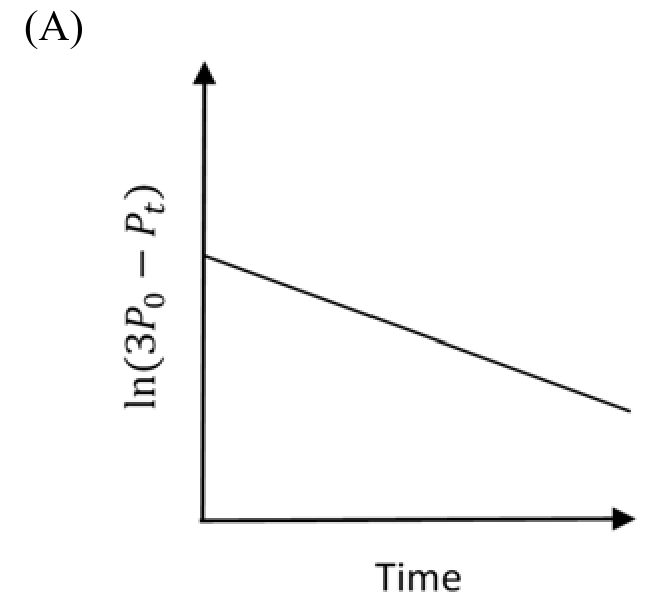
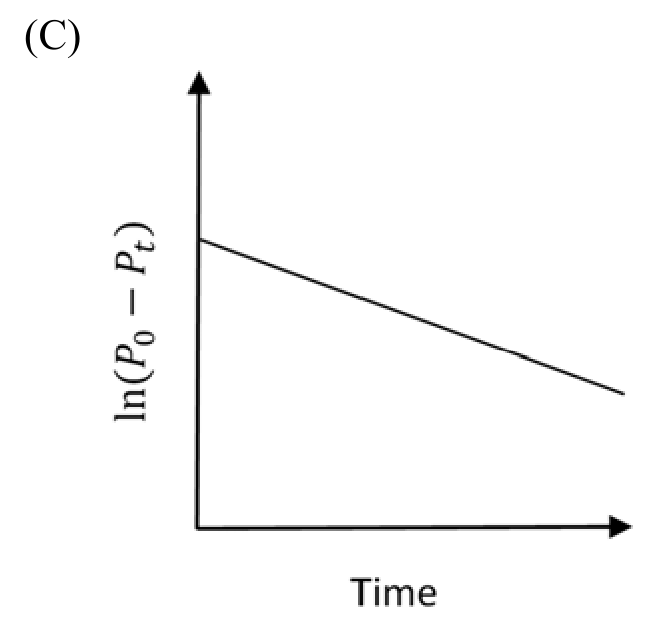
1. Pressure-Time Relationship (Analysis of Graphs A and C)
Let the initial pressure of gas at time be . At time , let be the decrease in the partial pressure of . The partial pressures of each species are:
The total pressure at time is the sum of the partial pressures:
Solving for :
Now, the partial pressure of at time is:
For a first-order reaction, the integrated rate law in terms of partial pressure is:
Substituting :
This equation is of the form , where:
- (negative slope)
Thus, a plot of vs is a straight line with a negative slope.
- Option (A) is correct.
- Option (C) is incorrect.
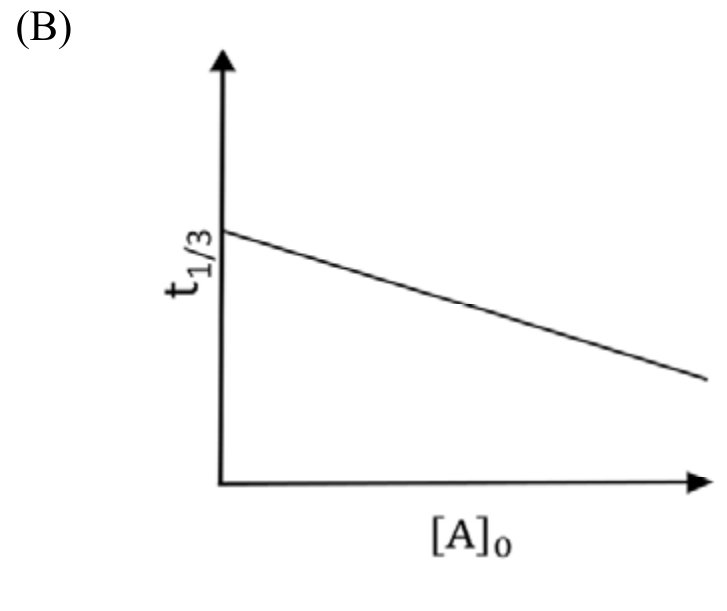
2. Dependence of on (Analysis of Graph B)
is the time required for the partial pressure of to reach of its initial value ().
Using the first-order rate equation:
For a first-order reaction, is independent of the initial concentration or initial pressure . The plot of vs should be a horizontal line parallel to the -axis.
- Option (B) is incorrect.
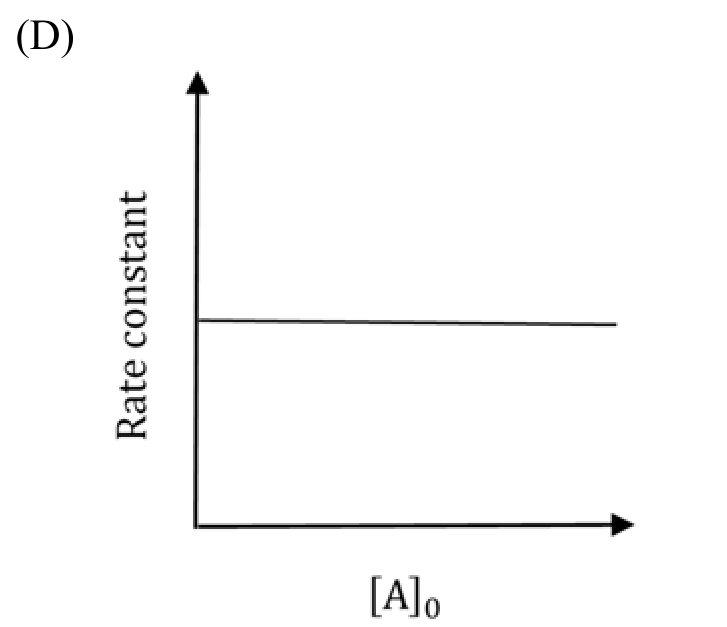
3. Dependence of Rate Constant on (Analysis of Graph D)
The rate constant depends only on temperature (Arrhenius equation) and is independent of the concentration of reactants. Since the temperature is kept constant at , remains constant regardless of .
Therefore, the plot of Rate constant vs is a horizontal straight line.
- Option (D) is correct.
Conclusion:
The correct options are A and D.