JEE Challenger
More from Alcohols, Phenols and Ethers

Synthesis of Cumene Hydroperoxide Derivative from Benzene

Identify the major reaction product U\mathbf{U} resulting from the following two-step transformation:

Question Diagram 1

Options

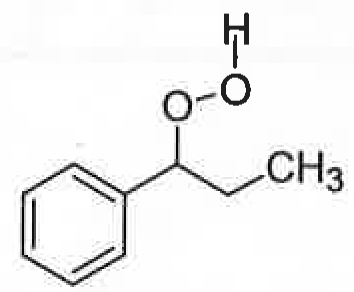
A
Option A Diagram 1
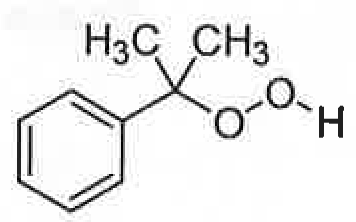
B
Option B Diagram 1
Correct
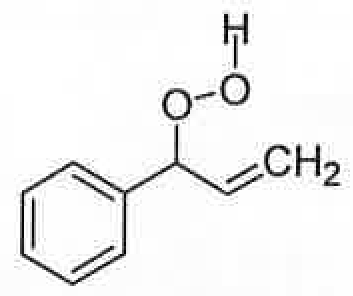
C
Option C Diagram 1
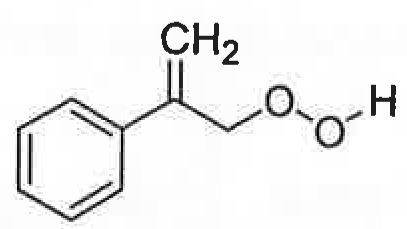
D
Option D Diagram 1

Step-by-Step Solution

To determine the major product U\mathbf{U}, we analyze the two steps of the reaction mechanism:

Step 1: Formation of Intermediate T\mathbf{T} (Friedel-Crafts Alkylation)

In the presence of an acid catalyst (H+\text{H}^+), propene (CH2=CH−CH3\text{CH}_2=\text{CH}-\text{CH}_3) undergoes protonation to form the more stable 2∘2^\circ isopropyl carbocation: CH2=CH−CH3+H+⟶CH3−C+H−CH3\text{CH}_2=\text{CH}-\text{CH}_3 + \text{H}^+ \longrightarrow \text{CH}_3-\overset{+}{\text{C}}\text{H}-\text{CH}_3

The secondary carbocation acts as an electrophile and attacks the benzene ring via electrophilic aromatic substitution to form cumene (isopropylbenzene): C6H6+CH3−C+H−CH3→−H+C6H5−CH(CH3)2(Intermediate T)\text{C}_6\text{H}_6 + \text{CH}_3-\overset{+}{\text{C}}\text{H}-\text{CH}_3 \xrightarrow{-\text{H}^+} \text{C}_6\text{H}_5-\text{CH}(\text{CH}_3)_2 \quad (\text{Intermediate }\mathbf{T})


Step 2: Conversion of Intermediate T\mathbf{T} to Product U\mathbf{U} (Autoxidation)

When cumene (T\mathbf{T}) is exposed to molecular oxygen (O2\text{O}_2) in the presence of a radical initiator, it undergoes a free-radical chain oxidation reaction:

  1. Initiation: The radical initiator abstracts the tertiary benzylic hydrogen atom (which has a low bond dissociation energy due to resonance stabilization of the resulting radical by the aromatic ring) to form the tertiary benzylic radical: C6H5−CH(CH3)2→InitiatorC6H5−C˙(CH3)2+H∙\text{C}_6\text{H}_5-\text{CH}(\text{CH}_3)_2 \xrightarrow{\text{Initiator}} \text{C}_6\text{H}_5-\dot{\text{C}}(\text{CH}_3)_2 + \text{H}^\bullet

  2. Propagation:

    • The benzylic radical rapidly reacts with oxygen to form a cumylperoxy radical: C6H5−C˙(CH3)2+O2⟶C6H5−C(CH3)2−O−O∙\text{C}_6\text{H}_5-\dot{\text{C}}(\text{CH}_3)_2 + \text{O}_2 \longrightarrow \text{C}_6\text{H}_5-\text{C}(\text{CH}_3)_2-\text{O}-\text{O}^\bullet
    • The peroxy radical then abstracts a hydrogen atom from another cumene molecule, generating cumene hydroperoxide and propagating the radical chain: C6H5−C(CH3)2−O−O∙+C6H5−CH(CH3)2⟶C6H5−C(CH3)2−O−O−H+C6H5−C˙(CH3)2\text{C}_6\text{H}_5-\text{C}(\text{CH}_3)_2-\text{O}-\text{O}^\bullet + \text{C}_6\text{H}_5-\text{CH}(\text{CH}_3)_2 \longrightarrow \text{C}_6\text{H}_5-\text{C}(\text{CH}_3)_2-\text{O}-\text{O}-\text{H} + \text{C}_6\text{H}_5-\dot{\text{C}}(\text{CH}_3)_2

Thus, the major product U\mathbf{U} is Cumene Hydroperoxide, which corresponds to structure (B).

Correct Answer: (B)