Major Product Formation in Diazotization and Azo Coupling Reaction
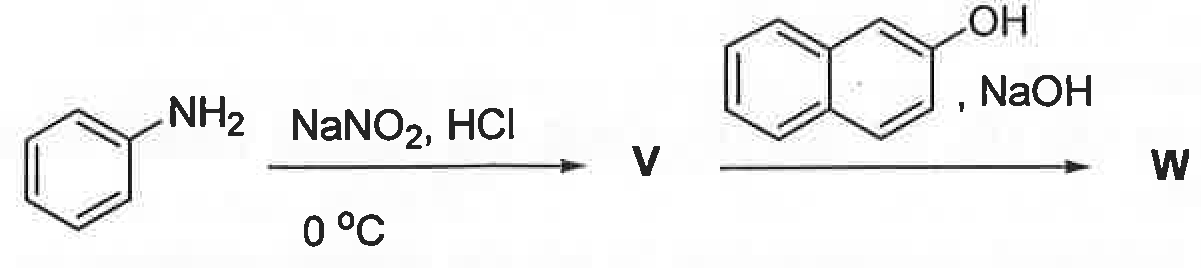
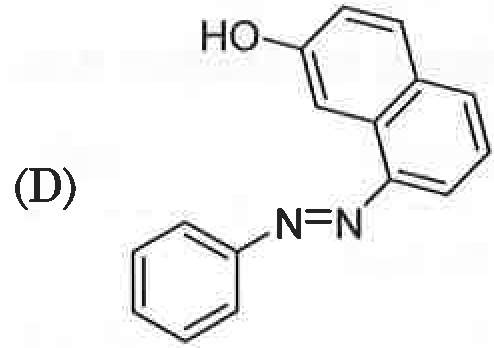
For the chemical reaction sequence shown below, identify the correct structure of the major product :
Options
Topics & Concepts
Step-by-Step Solution
To determine the correct structure of the major product , let us break down the reaction sequence step by step:
Step 1: Formation of Intermediate (Diazotization)
When aniline () is treated with sodium nitrite () and hydrochloric acid () at , it undergoes a diazotization reaction to form benzenediazonium chloride:
Thus, intermediate is benzenediazonium chloride ().
Step 2: Formation of Major Product (Azo Coupling Reaction)
When intermediate reacts with 2-naphthol (-naphthol) in the presence of sodium hydroxide (), an electrophilic aromatic substitution (azo coupling) reaction occurs:
-
Role of : In alkaline medium, 2-naphthol is deprotonated to form the 2-naphthoxide ion, which significantly activates the aromatic ring towards electrophilic attack due to strong resonance donation ( effect) of the phenoxide oxygen:
-
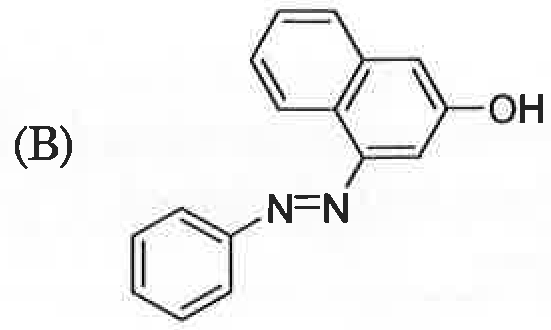
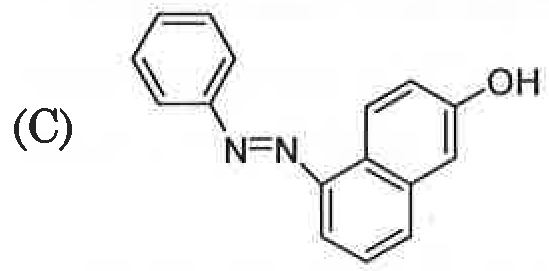
Regioselectivity: The weak electrophile, benzenediazonium ion (), preferentially attacks the 1-position (-position adjacent to the group) rather than the 3-position or positions on the other ring.
- Electrophilic substitution at yields a carbocation intermediate (Wheland complex) in which the aromaticity of the adjacent benzene ring remains completely intact.
- Attack at interrupts the benzene ring's aromatic resonance, making kinetically and thermodynamically favored.
-
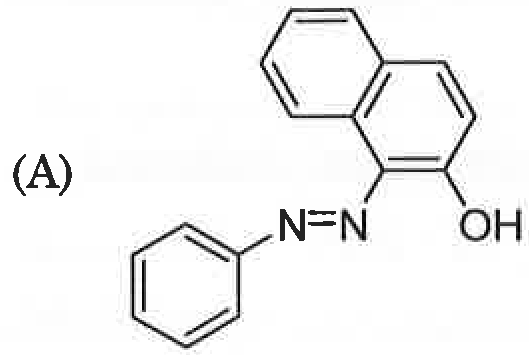
Deprotonation from restores aromaticity in the substituted ring, forming 1-(phenylazo)-2-naphthol (a red-orange azo dye) as the major product :
Conclusion:
The structure corresponding to 1-(phenylazo)-2-naphthol is given in Option (A).
Correct Option: A