Ozonolysis and Reductive Ring Formation of Methyl Indene
In the following sequence of reactions, determine the identity of the product :

Options
Step-by-Step Solution
To determine the identity of the product , we trace the reaction sequence step by step:
Step 1: Ozonolysis of the Alkene Derivative (Formation of R)
The starting material is a substituted indene derivative containing a fused benzene ring and a cyclopentene ring with a methyl group () at the top-left position of the benzene ring.
Under reductive ozonolysis conditions:
- selectively cleaves the more electron-rich, non-aromatic carbon-carbon double bond () in the five-membered ring.
- Subsequent reduction with yields a dicarbonyl compound , containing:
- An aromatic aldehyde group () attached directly to the benzene ring.
- An aliphatic aldehyde group () attached to the adjacent position of the benzene ring.
The structure of is 2-(2-oxoethyl)benzaldehyde with the substituent intact at the position meta to the group and para to the direct group (top-left).
Step 2: Reaction with Ammonia () (Formation of S)
The 1,5-dicarbonyl compound undergoes nucleophilic attack by ammonia ():
- The lone pair on ammonia attacks one of the aldehyde carbonyl carbons, followed by intramolecular attack on the second aldehyde carbonyl carbon to form a six-membered cyclic intermediate.
- Subsequent dehydration (loss of two molecules of ) and aromatization results in the formation of a stable isoquinoline ring system.
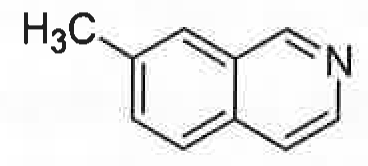
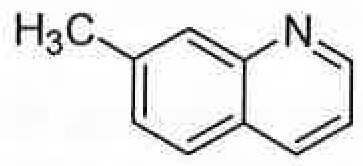
Since the cyclization of 2-(2-oxoethyl)benzaldehyde with yields isoquinoline (where the nitrogen atom is at position , not at position as in quinoline), the resulting product is 7-methylisoquinoline.
Conclusion:
Comparing with the given options:
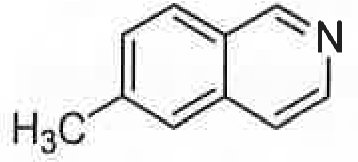
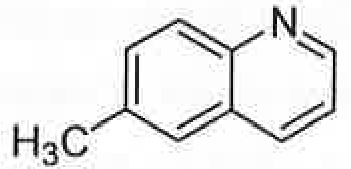
- (A) correctly shows the isoquinoline ring (with nitrogen at position ) and the methyl group located at position (top-left).
Therefore, the correct option is (A).