JEE Challenger
More from Mechanical Properties of Fluids

Steady Mass Flow Rate of Air Exiting Vertical Chimney

Comprehension Passage

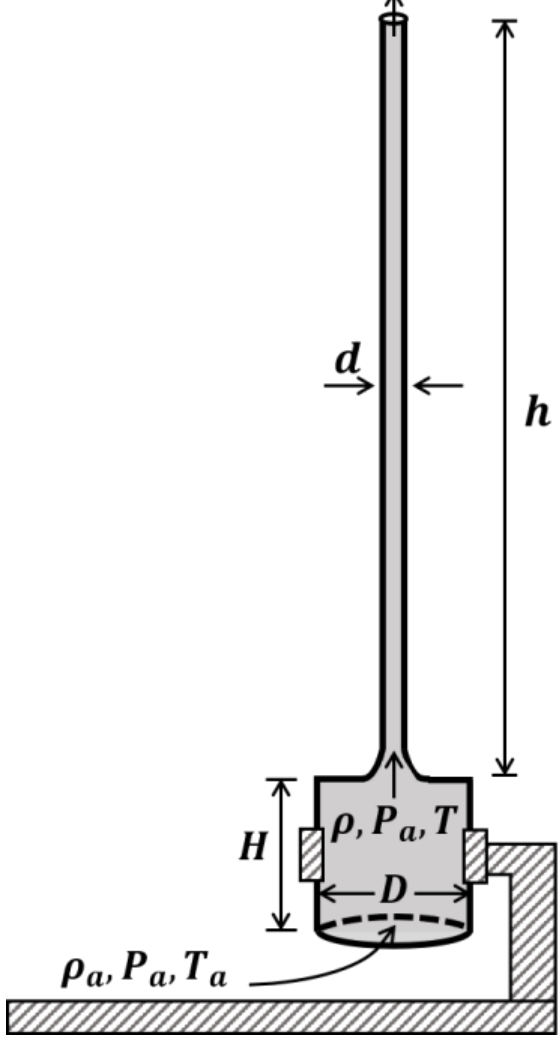
A cylindrical furnace has height (HH) and diameter (DD) both 1 m1\text{ m}. It is maintained at temperature 360 K360\text{ K}. The air gets heated inside the furnace at constant pressure PaP_a and its temperature becomes T=360 KT = 360\text{ K}. The hot air with density ρ\rho rises up a vertical chimney of diameter d=0.1 md = 0.1\text{ m} and height h=9 mh = 9\text{ m} above the furnace and exits the chimney (see the figure). As a result, atmospheric air of density ρa=1.2 kg m3\rho_a = 1.2\text{ kg m}^{-3}, pressure PaP_a and temperature Ta=300 KT_a = 300\text{ K} enters the furnace. Assume air as an ideal gas, neglect the variations in ρ\rho and TT inside the chimney and the furnace. Also ignore the viscous effects.

[Given: The acceleration due to gravity g=10 m s2g = 10\text{ m s}^{-2} and π=3.14\pi = 3.14]

Considering the air flow to be streamline, the steady mass flow rate of air exiting the chimney is ______ gm s1\text{gm s}^{-1}.

Question Diagram 1
Official Numerical Answer49.6 to 49.7

Step-by-Step Solution

To find the steady mass flow rate of air exiting the chimney, we proceed step-by-step:

Step 1: Calculate the density of hot air inside the furnace and chimney

Air is assumed to be an ideal gas. Since it is heated inside the furnace at a constant pressure PaP_a, we can write: Pa=ρaRTaM=ρRTMP_a = \frac{\rho_a R T_a}{M} = \frac{\rho R T}{M}

Thus, the density of the hot air ρ\rho inside the furnace and chimney is given by: ρ=ρa(TaT)\rho = \rho_a \left( \frac{T_a}{T} \right)

Given values:

  • ρa=1.2 kg m3\rho_a = 1.2\text{ kg m}^{-3}
  • Ta=300 KT_a = 300\text{ K}
  • T=360 KT = 360\text{ K}

ρ=1.2×300360=1.0 kg m3\rho = 1.2 \times \frac{300}{360} = 1.0\text{ kg m}^{-3}


Step 2: Apply Bernoulli's equation along a streamline

Consider a streamline starting from the entrance at the bottom of the furnace (z=0z = 0) to the exit at the top of the chimney (z=H+hz = H + h).

  1. At the entrance (z=0z = 0):

    • Pressure: P1=PaP_1 = P_a
    • Height: z1=0z_1 = 0
    • Air velocity: v10v_1 \approx 0 (since the atmospheric air far from the furnace is stationary)
  2. At the exit of the chimney (z=H+hz = H + h):

    • Height: z2=H+h=1 m+9 m=10 mz_2 = H + h = 1\text{ m} + 9\text{ m} = 10\text{ m}
    • Air velocity: v2=vv_2 = v
    • External atmospheric pressure at height z2z_2: Pout(H+h)=Paρag(H+h)P_{out}(H+h) = P_a - \rho_a g (H+h) Since the air exits into the surrounding atmosphere, the pressure at the chimney exit is equal to the local atmospheric pressure: P2=Paρag(H+h)P_2 = P_a - \rho_a g (H+h)

Applying Bernoulli's equation for the hot air flowing inside: P1+ρgz1+12ρv12=P2+ρgz2+12ρv22P_1 + \rho g z_1 + \frac{1}{2}\rho v_1^2 = P_2 + \rho g z_2 + \frac{1}{2}\rho v_2^2

Substituting the known values: Pa+0+0=[Paρag(H+h)]+ρg(H+h)+12ρv2P_a + 0 + 0 = \left[ P_a - \rho_a g (H+h) \right] + \rho g (H+h) + \frac{1}{2}\rho v^2

Simplifying the expression: 0=ρag(H+h)+ρg(H+h)+12ρv20 = - \rho_a g (H+h) + \rho g (H+h) + \frac{1}{2}\rho v^2

12ρv2=(ρaρ)g(H+h)\frac{1}{2}\rho v^2 = (\rho_a - \rho) g (H+h)

v=2(ρaρ)g(H+h)ρv = \sqrt{\frac{2(\rho_a - \rho) g (H+h)}{\rho}}


Step 3: Calculate the exit velocity (vv)

Substitute the given values into the velocity equation:

  • g=10 m s2g = 10\text{ m s}^{-2}
  • H+h=10 mH + h = 10\text{ m}
  • ρa=1.2 kg m3\rho_a = 1.2\text{ kg m}^{-3}
  • ρ=1.0 kg m3\rho = 1.0\text{ kg m}^{-3}

v=2×(1.21.0)×10×101.0=2×0.2×100=40=210 m s16.32455 m s1v = \sqrt{\frac{2 \times (1.2 - 1.0) \times 10 \times 10}{1.0}} = \sqrt{2 \times 0.2 \times 100} = \sqrt{40} = 2\sqrt{10}\text{ m s}^{-1} \approx 6.32455\text{ m s}^{-1}


Step 4: Calculate the steady mass flow rate

The cross-sectional area of the chimney of diameter d=0.1 md = 0.1\text{ m} is: A=πd24=3.14×(0.1)24=7.85×10³ m2A = \frac{\pi d^2}{4} = \frac{3.14 \times (0.1)^2}{4} = 7.85 \times 10^{-3}\text{ m}^2

The steady mass flow rate dmdt\frac{dm}{dt} of air exiting the chimney is given by: dmdt=ρAv\frac{dm}{dt} = \rho A v

dmdt=1.0 kg m3×(7.85×103 m2)×40 m s1\frac{dm}{dt} = 1.0\text{ kg m}^{-3} \times (7.85 \times 10^{-3}\text{ m}^2) \times \sqrt{40}\text{ m s}^{-1}

dmdt=7.85×103×6.32455 kg s10.049648 kg s1\frac{dm}{dt} = 7.85 \times 10^{-3} \times 6.32455\text{ kg s}^{-1} \approx 0.049648\text{ kg s}^{-1}

Converting to grams per second (gm s1\text{gm s}^{-1}): dmdt=0.049648×1000 gm s1=49.65 gm s1\frac{dm}{dt} = 0.049648 \times 1000\text{ gm s}^{-1} = 49.65\text{ gm s}^{-1}

(Rounding to two decimal places gives 49.65 gm s149.65\text{ gm s}^{-1} or within the range of 49.6049.70 gm s149.60 - 49.70\text{ gm s}^{-1})