Beat Frequency Measured by Sound Detector from Two Moving Sources
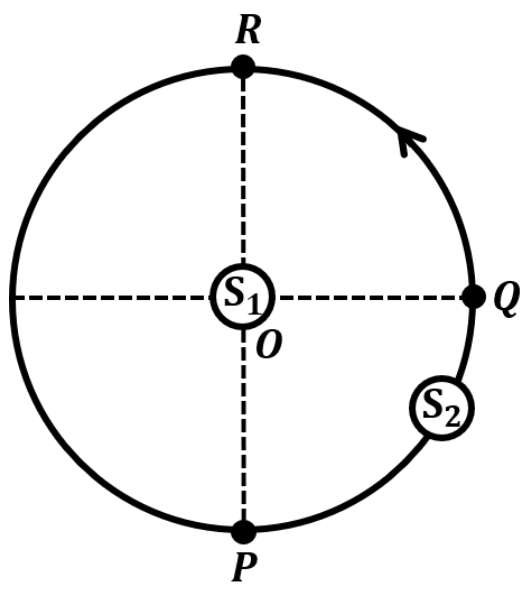
and are two identical sound sources of frequency . The source is located at and moves anti-clockwise with a uniform speed on a circular path around , as shown in the figure. There are three points , and on this path such that and are diametrically opposite while is equidistant from them. A sound detector is placed at point . The source can move along direction .
[Given: The speed of sound in air is ]
Consider both sources emitting sound. When is at and approaches the detector with a speed , the beat frequency measured by the detector is _______ Hz.
Topics & Concepts
Step-by-Step Solution
To find the beat frequency measured by the sound detector placed at point , we need to calculate the apparent frequencies of the sound waves received from both sources and .
1. Frequency received from Source :
- The detector is placed at point , which is at the bottom of the circular path.
- Source is at point , which is diametrically opposite to (at the top of the circular path).
- moves anti-clockwise in a circle. At point , the velocity vector of is directed horizontally to the left.
- The line joining the source at and the detector at is along the vertical diameter .
- Therefore, the velocity vector of is perpendicular to the line of sight joining and .
- The component of velocity of towards the detector at is:
Hence, there is no Doppler shift for the sound emitted by and received at :
2. Frequency received from Source :
- Source moves along the line directly approaching the detector at with a speed of .
- The speed of sound in air is .
- Using the Doppler effect formula for a moving source approaching a stationary observer:
Substitute the given values into the equation:
3. Calculation of Beat Frequency:
The beat frequency detected at point is the absolute difference between the two received frequencies:
The beat frequency measured by the detector is 8.2 (or 8.2 Hz).