Calculate Pressure Difference at Chimney Cap
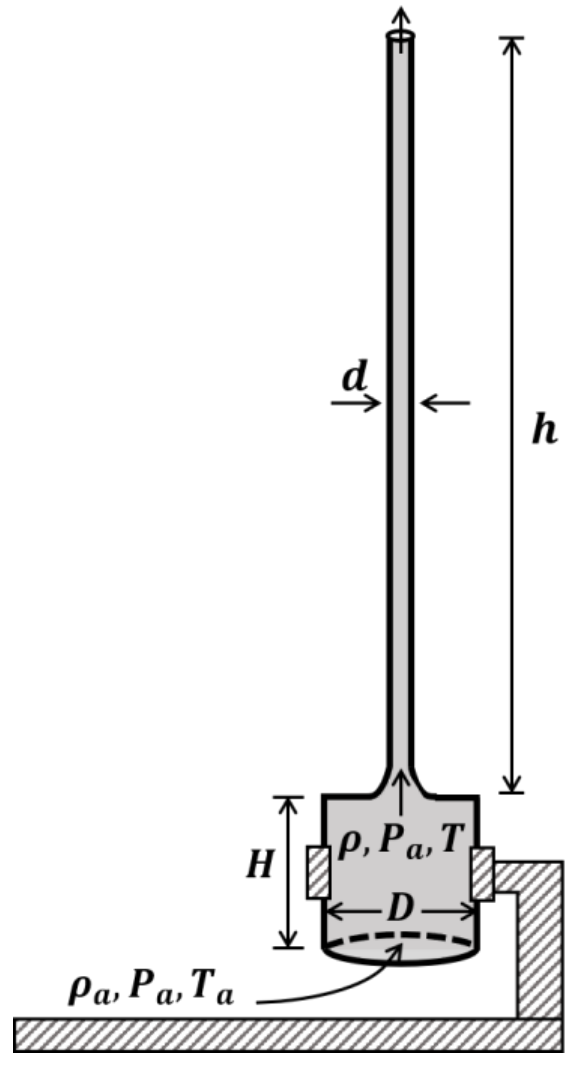
A cylindrical furnace has height () and diameter () both . It is maintained at temperature . The air gets heated inside the furnace at constant pressure and its temperature becomes . The hot air with density rises up a vertical chimney of diameter and height above the furnace and exits the chimney (see the figure). As a result, atmospheric air of density , pressure and temperature enters the furnace. Assume air as an ideal gas, neglect the variations in and inside the chimney and the furnace. Also ignore the viscous effects.
[Given: The acceleration due to gravity and ]
When the chimney is closed using a cap at the top, a pressure difference develops between the top and the bottom surfaces of the cap. If the changes in the temperature and density of the hot air, due to the stoppage of air flow, are negligible then the value of is ______ .
Topics & Concepts
Step-by-Step Solution
To find the pressure difference between the top and bottom surfaces of the cap when the chimney is closed, we proceed step-by-step:
1. Density of the Hot Air ()
Assuming air behaves as an ideal gas, the pressure, density, and temperature are related by .
Since the air enters the furnace at pressure and stays at constant pressure inside the furnace:
Substituting the given values (, , and ):
2. Pressure Distribution
Let correspond to the bottom of the furnace, where atmospheric air enters and the pressure both inside and outside is .
The total height of the hot air column from the bottom of the furnace to the top of the chimney is:
-
Outside Pressure at the top of the cap (): Due to the ambient air column of density :
-
Inside Pressure at the bottom of the cap (): Due to the hot air column of density :
3. Calculation of Pressure Difference ()
The pressure difference across the cap is:
Substituting the values ():
Final Answer: The value of is 20.