JEE Challenger
More from Biomolecules

Specific Rotation of Sugar Derivatives Produced by Nitric Acid Oxidation

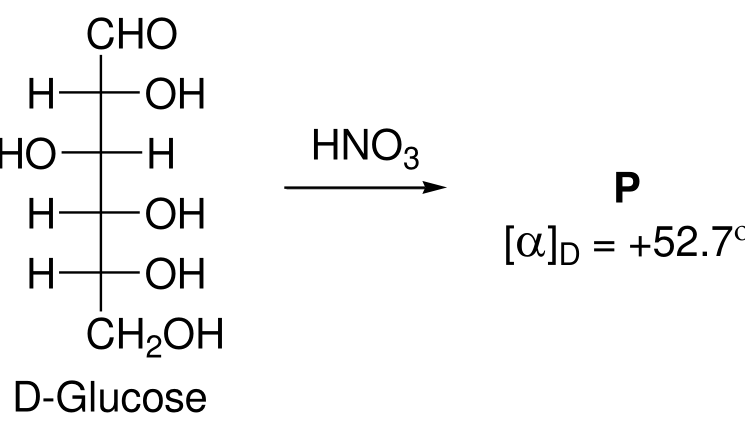
Consider the oxidation reaction shown below:

Which of the following compound(s), upon treatment with HNO3\text{HNO}_3, will yield a product exhibiting a specific optical rotation of [α]D=−52.7∘[\alpha]_D = -52.7^\circ?

Question Diagram 1

Options

A
Option A
B
Option B
C
Option C
Correct
D
Option D
Correct

Step-by-Step Solution

When D-glucose is treated with concentrated HNO3\text{HNO}_3, both the terminal aldehyde group (−CHO-\text{CHO}) at C-1\text{C-1} and the primary alcohol group (−CH2OH-\text{CH}_2\text{OH}) at C-6\text{C-6} are oxidized to carboxylic acid (−COOH-\text{COOH}) groups. This forms an aldaric acid, specifically D-glucaric acid (P\mathbf{P}).

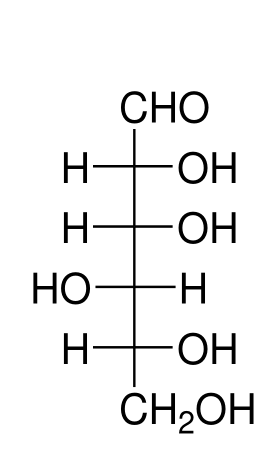
The Fischer projection of D-glucose and its oxidation product P\mathbf{P} (D-glucaric acid) with [α]D=+52.7∘[\alpha]_D = +52.7^\circ is given by:

D-glucose→HNO3P([α]D=+52.7∘)\text{D-glucose} \xrightarrow{\text{HNO}_3} \mathbf{P} \quad ([\alpha]_D = +52.7^\circ)

CHO∣H−C−OH∣HO−C−H∣H−C−OH∣H−C−OH∣CH2OH→HNO3COOH∣H−C−OH(Right)∣HO−C−H(Left)∣H−C−OH(Right)∣H−C−OH(Right)∣COOH\begin{array}{c} \text{CHO} \\ | \\ \text{H} - \text{C} - \text{OH} \\ | \\ \text{HO} - \text{C} - \text{H} \\ | \\ \text{H} - \text{C} - \text{OH} \\ | \\ \text{H} - \text{C} - \text{OH} \\ | \\ \text{CH}_2\text{OH} \end{array} \xrightarrow{\text{HNO}_3} \begin{array}{c} \text{COOH} \\ | \\ \text{H} - \text{C} - \text{OH} \quad (\text{Right}) \\ | \\ \text{HO} - \text{C} - \text{H} \quad (\text{Left}) \\ | \\ \text{H} - \text{C} - \text{OH} \quad (\text{Right}) \\ | \\ \text{H} - \text{C} - \text{OH} \quad (\text{Right}) \\ | \\ \text{COOH} \end{array}

Thus, the spatial orientation of the −OH-\text{OH} groups from C-2\text{C-2} to C-5\text{C-5} in D-glucaric acid (P\mathbf{P}) is (Right,Left,Right,Right)(\text{Right}, \text{Left}, \text{Right}, \text{Right}).

To obtain a product with an optical rotation of [α]D=−52.7∘[\alpha]_D = -52.7^\circ, the oxidation product must be the enantiomer of D-glucaric acid, which is L-glucaric acid (P′\mathbf{P'}).

The Fischer projection of L-glucaric acid (P′\mathbf{P'}) has the inverted configuration at all chiral centers:

P′([α]D=−52.7∘)=COOH∣HO−C−H(Left)∣H−C−OH(Right)∣HO−C−H(Left)∣HO−C−H(Left)∣COOH\mathbf{P'} \quad ([\alpha]_D = -52.7^\circ) = \begin{array}{c} \text{COOH} \\ | \\ \text{HO} - \text{C} - \text{H} \quad (\text{Left}) \\ | \\ \text{H} - \text{C} - \text{OH} \quad (\text{Right}) \\ | \\ \text{HO} - \text{C} - \text{H} \quad (\text{Left}) \\ | \\ \text{HO} - \text{C} - \text{H} \quad (\text{Left}) \\ | \\ \text{COOH} \end{array}

The −OH-\text{OH} orientation sequence for P′\mathbf{P'} from C-2\text{C-2} to C-5\text{C-5} is (Left,Right,Left,Left)(\text{Left}, \text{Right}, \text{Left}, \text{Left}).

Since a 180∘180^\circ rotation of a Fischer projection in the plane of the page yields an identical representation of a molecule:

  • Top (−COOH-\text{COOH}) and Bottom (−COOH-\text{COOH}) swap places.
  • C-2\text{C-2} swaps with C-5\text{C-5}, and C-3\text{C-3} swaps with C-4\text{C-4}.
  • Left substituents move to the Right, and Right substituents move to the Left.

Under a 180∘180^\circ in-plane rotation, the configuration sequence (s2,s3,s4,s5)(s_2, s_3, s_4, s_5) transforms to: (s2′,s3′,s4′,s5′)=(opp(s5),opp(s4),opp(s3),opp(s2))(s'_2, s'_3, s'_4, s'_5) = (\text{opp}(s_5), \text{opp}(s_4), \text{opp}(s_3), \text{opp}(s_2))

Applying this to L-glucaric acid (Left,Right,Left,Left)(\text{Left}, \text{Right}, \text{Left}, \text{Left}) gives: (opp(Left),opp(Left),opp(Right),opp(Left))=(Right,Right,Left,Right)(\text{opp}(\text{Left}), \text{opp}(\text{Left}), \text{opp}(\text{Right}), \text{opp}(\text{Left})) = (\text{Right}, \text{Right}, \text{Left}, \text{Right})

Therefore, any substrate whose oxidation product has an −OH-\text{OH} configuration sequence of either (Left,Right,Left,Left)(\text{Left}, \text{Right}, \text{Left}, \text{Left}) or (Right,Right,Left,Right)(\text{Right}, \text{Right}, \text{Left}, \text{Right}) will produce L-glucaric acid (P′\mathbf{P'}), exhibiting [α]D=−52.7∘[\alpha]_D = -52.7^\circ.


Analysis of the Options:

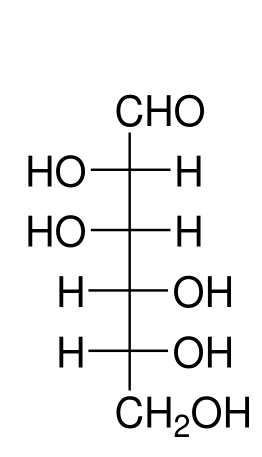
  1. Option (A):

    • Configuration from C-2\text{C-2} to C-5\text{C-5}: (Left,Left,Right,Right)(\text{Left}, \text{Left}, \text{Right}, \text{Right}).
    • Oxidation product sequence: (Left,Left,Right,Right)(\text{Left}, \text{Left}, \text{Right}, \text{Right}).
    • This does not match L-glucaric acid.
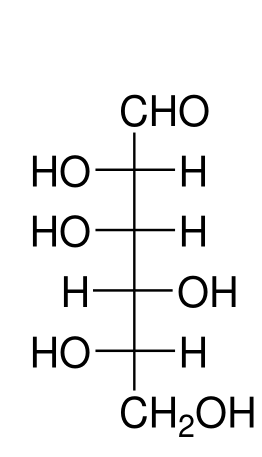
  2. Option (B):

    • Configuration from C-2\text{C-2} to C-5\text{C-5}: (Left,Left,Right,Left)(\text{Left}, \text{Left}, \text{Right}, \text{Left}) (L-gulose).
    • A 180∘180^\circ rotation of its oxidized product gives (Right,Left,Right,Right)(\text{Right}, \text{Left}, \text{Right}, \text{Right}), which is D-glucaric acid (P\mathbf{P}), having [α]D=+52.7∘[\alpha]_D = +52.7^\circ.
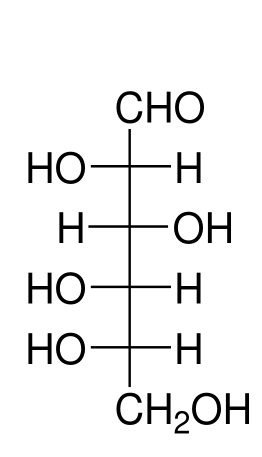
  3. Option (C):

    • Configuration from C-2\text{C-2} to C-5\text{C-5}: (Left,Right,Left,Left)(\text{Left}, \text{Right}, \text{Left}, \text{Left}) (L-glucose).
    • Upon oxidation with HNO3\text{HNO}_3, it directly yields L-glucaric acid (P′\mathbf{P'}), which has [α]D=−52.7∘[\alpha]_D = -52.7^\circ.
    • Correct option.
  4. Option (D):

    • Configuration from C-2\text{C-2} to C-5\text{C-5}: (Right,Right,Left,Right)(\text{Right}, \text{Right}, \text{Left}, \text{Right}) (D-gulose).
    • Upon oxidation with HNO3\text{HNO}_3, the product has sequence (Right,Right,Left,Right)(\text{Right}, \text{Right}, \text{Left}, \text{Right}). Rotating this product by 180∘180^\circ in-plane yields (Left,Right,Left,Left)(\text{Left}, \text{Right}, \text{Left}, \text{Left}), which is identical to L-glucaric acid (P′\mathbf{P'}), having [α]D=−52.7∘[\alpha]_D = -52.7^\circ.
    • Correct option.

Conclusion:

The compounds in options (C) and (D) yield a product with [α]D=−52.7∘[\alpha]_D = -52.7^\circ.