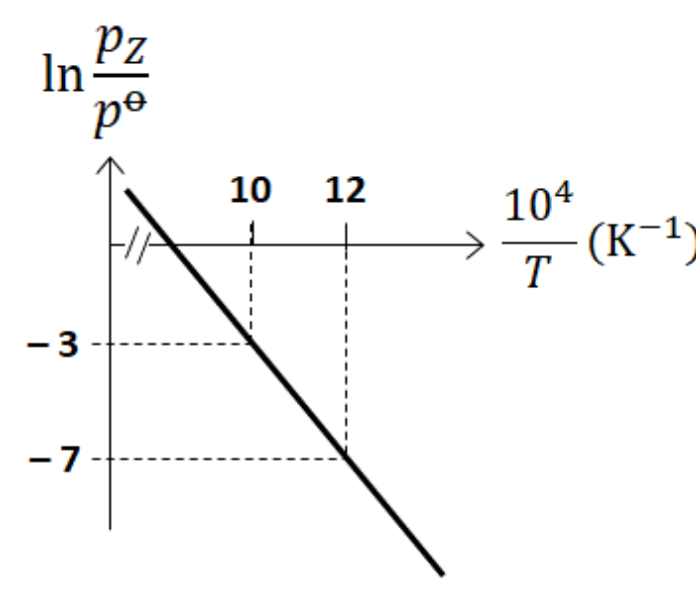
To find the standard entropy change, ΔS⊖, for the given reaction at T=1000 K, we utilize the thermodynamic relationships connecting the equilibrium constant (K), standard enthalpy change (ΔH⊖), and standard entropy change (ΔS⊖).
Step 1: Express lnK in terms of temperature T
The standard Gibbs free energy change is given by:
ΔG⊖=ΔH⊖−TΔS⊖
Also, the relationship between ΔG⊖ and the equilibrium constant K is:
ΔG⊖=−RTlnK
Equating the two expressions for ΔG⊖:
−RTlnK=ΔH⊖−TΔS⊖
Dividing both sides by −RT:
lnK=−RΔH⊖(T1)+RΔS⊖
Let x=T104, so T1=10−4x. Substituting this gives:
lnK=(−104RΔH⊖)x+RΔS⊖
This represents a linear equation of the form lnK=mx+c, where:
- Slope, m=−104RΔH⊖
- Intercept, c=RΔS⊖
Step 2: Determine the line parameters from the graph
From the given plot of lnK against x=T104:
- At x1=10, lnK1=−3
- At x2=12, lnK2=−7
The slope m of the line is calculated as:
m=x2−x1lnK2−lnK1=12−10−7−(−3)=2−4=−2
Using the point-slope form with (x1,lnK1)=(10,−3):
lnK−(−3)=−2(x−10)
lnK+3=−2x+20
lnK=−2x+17
Step 3: Calculate the Standard Entropy Change ΔS⊖
Comparing the equation lnK=−2x+17 with lnK=(−104RΔH⊖)x+RΔS⊖, we find the intercept c:
RΔS⊖=17
Therefore:
ΔS⊖=17×R
Given R=8.314 J K−1 mol−1:
ΔS⊖=17×8.314=141.338 J K−1 mol−1
Rounding to two decimal places:
ΔS⊖≈141.34 J K−1 mol−1