Nucleophilic Substitution and Carius Detection Test for Organic Substrate
When compound is reacted with , it forms a major organic product that gives a positive Carius test following treatment with and subsequent addition of . Identify the correct option(s) representing potential structure(s) of .
Options
Step-by-Step Solution
To determine which structure(s) of compound yield a major organic product that gives a positive Carius test for sulfur, let us analyze the chemical reactions involved:
1. Principle of the Carius Test for Sulfur
When an organic compound containing sulfur is oxidized using sodium peroxide (), the sulfur atom is converted into sulfate ions (). Subsequent addition of barium chloride () results in the formation of a white precipitate of barium sulfate ():
Thus, for to give a positive Carius test after reaction with , the major organic product formed must contain sulfur.
2. Analysis of the Options
-
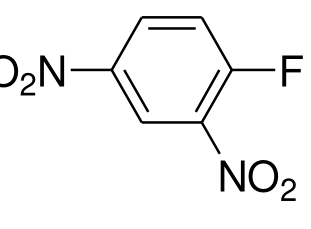
Option (A): 1-fluoro-2,4-dinitrobenzene
- The fluorine atom is activated towards Nucleophilic Aromatic Substitution () because the strongly electron-withdrawing nitro groups () are located at the ortho (position 2) and para (position 4) positions relative to the fluorine atom.
- The thiolate nucleophile () attacks the ring, displacing via a Meisenheimer complex intermediate:
- The product, (2,4-dinitrophenyl)(phenyl)sulfide, contains a thioether linkage () and therefore gives a positive Carius test for sulfur.
- Option (A) is correct.
-
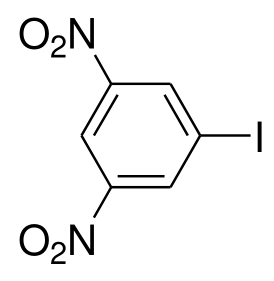
Option (B): 1-iodo-3,5-dinitrobenzene
- The nitro groups are located at the meta positions relative to the iodine atom.
- Meta-nitro groups cannot stabilize the Meisenheimer complex intermediate by resonance. Therefore, nucleophilic aromatic substitution () does not occur, and no sulfur-containing substitution product is formed.
- Option (B) is incorrect.
-
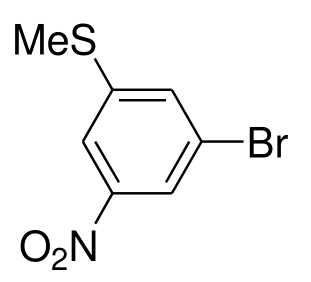
Option (C): 1-bromo-3-(methylthio)-5-nitrobenzene
- The bromine atom is meta to both the and groups, meaning it is not activated for substitution by .
- Since no nucleophilic substitution occurs to give the desired major product, Option (C) is incorrect.
-
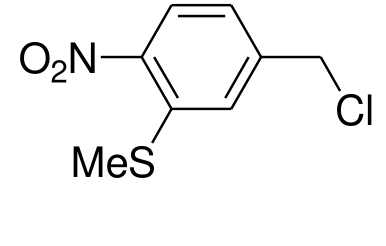
Option (D): 4-(methylthio)-3-nitrobenzyl chloride
- The compound contains a benzylic chloride () group.
- Benzylic halides undergo rapid nucleophilic substitution with :
- The resulting organic product contains sulfur atoms (both and ) and undergoes oxidation with followed by precipitation with to give a positive Carius test.
- Option (D) is correct.
Conclusion
The correct options representing potential structures of are (A) and (D).