Shape of Emergent Wavefront Through Non Uniform Glass Profile
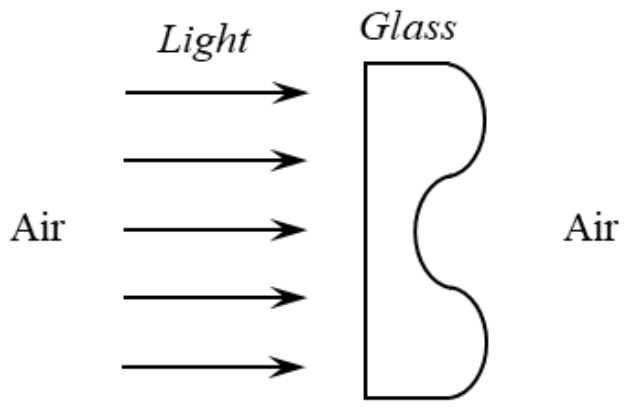
A parallel beam of light impinges upon a piece of transparent glass whose cross-section is depicted below. Identify the correct shape of the resulting emergent wavefront. (Note: schematics are not to scale).
Options




Topics & Concepts
Step-by-Step Solution
To determine the correct shape of the emergent wavefront, we analyze the optical path length of light rays passing through different sections of the glass block.
1. Concept of Wavefront and Optical Path Length (OPL)
A wavefront is a locus of points having the same phase. For a parallel beam of light incident normally from the left, the incident wavefronts are plane vertical surfaces.
Let the refractive index of the glass be and that of air be . Consider light traveling from a vertical line in air (before entering the glass) to a vertical line (after emerging from the glass).
If the thickness of the glass at height is , the Optical Path Length () traversed by the light ray at height is:
The time taken by light to cover this distance is:
Since , we have . Thus:
- A larger thickness corresponds to a larger optical path length and a greater time delay .
- Consequently, light passing through thicker regions of glass travels slower relative to light in air, causing the emergent wavefront to lag behind (i.e., be positioned further to the left, direction).
- Light passing through thinner regions experiences less delay and is further ahead (i.e., positioned further to the right, direction).
2. Analysis of the Glass Profile
The cross-section of the glass block shows:
- Upper and Lower Regions: The glass bulges outwards, meaning the thickness reaches two local maxima.
- Central Region: There is a notch/depression where the thickness reaches a local minimum.
3. Shape of the Emergent Wavefront
The position of the emergent wavefront at a given time is given by:
- At the upper and lower bulges (where is maximum), is minimum. The wavefront lags behind and curves towards the left.
- At the central depression (where is minimum), is maximum. The wavefront advances forward and curves towards the right.
Thus, the emergent wavefront features two depressions pointing to the left corresponding to the two thicker parts of the glass. This shape corresponds to Option (A).
Correct Option: (A)