Angular Momentum Gained by Coil Discharging Capacitor in Magnetic Field
A circular coil featuring turns and radius possesses negligible electrical resistance. As depicted in the schematic diagram, its two terminal wires hang vertically such that the plane of the loop remains vertical. These leads connect via a switch to a capacitor holding charge . The loop is situated in a uniform horizontal magnetic field parallel to its plane. Upon closing the switch, the capacitor discharges rapidly through the loop. Assuming the discharge duration is extremely small such that the coil barely rotates during this interval, find the magnitude of the angular momentum acquired by the coil.
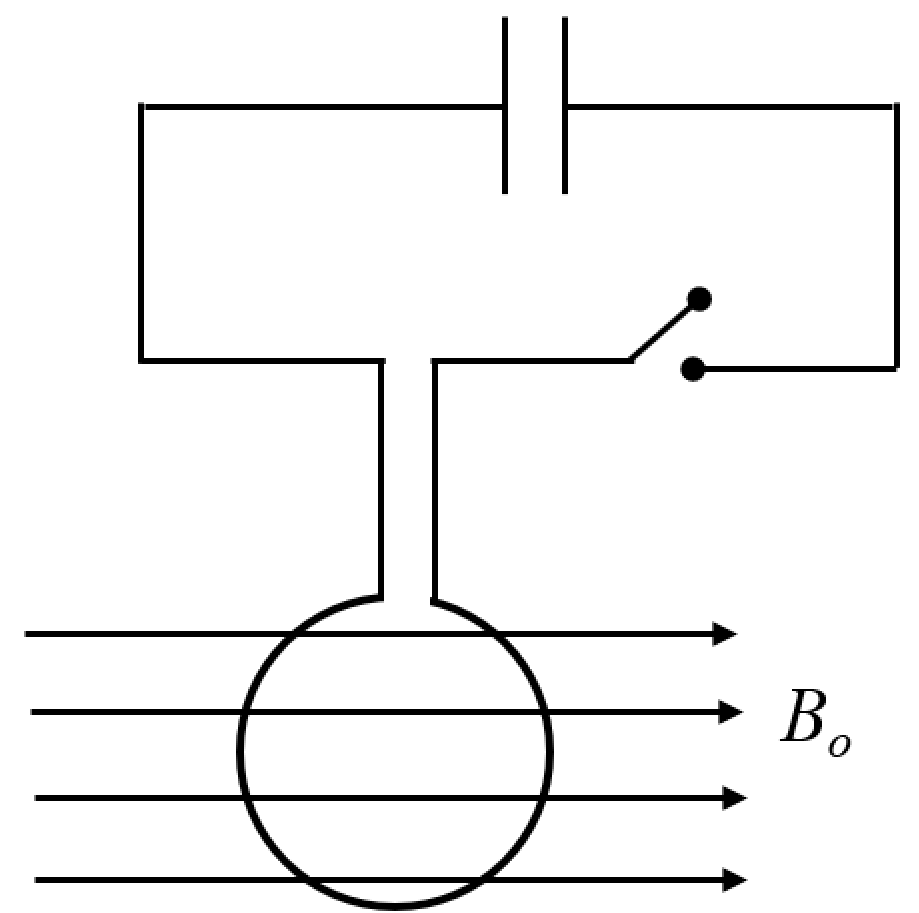
Options
Topics & Concepts
Step-by-Step Solution
To determine the magnitude of the angular momentum acquired by the coil, we calculate the magnetic torque exerted on the coil during the capacitor's discharge and integrate it over time.
1. Magnetic Dipole Moment of the Coil
The magnetic dipole moment of a coil carrying an instantaneous current with turns and radius is given by:
where is the area vector of the coil. The magnitude of the area vector is:
The vector points normal to the vertical plane of the loop.
2. Magnetic Torque on the Loop
The magnetic field is horizontal and parallel to the plane of the loop. Therefore, the angle between the normal vector (and hence ) and the magnetic field is .
The torque acting on the coil is given by:
The magnitude of the torque at any instant is:
3. Angular Momentum Gained by the Coil
The angular momentum acquired by the coil is equal to the angular impulse of the magnetic torque over the discharge duration :
Substituting the expression for :
Since the discharge happens extremely fast and the coil hardly rotates during this time, the orientation of the loop remains unchanged during the integration. Thus, and remain constant and can be taken out of the integral:
4. Total Charge Discharged
The integral of current over the discharge time represents the total charge originally stored on the capacitor:
Substituting this into the expression for angular momentum yields:
Conclusion
Thus, the magnitude of the angular momentum gained by the coil is:
This corresponds to Option (B).