Liquid Height Ratio in U Tube with Two Immiscible Fluids
An open U-tube having uniform cross-sectional area contains water with density . Initially, the level of water stands at from the bottom in both limbs. Kerosene oil (a water-immiscible fluid) of density is added into the left limb until its column length becomes , as shown in the diagram. Find the ratio of the fluid heights in the two limbs.
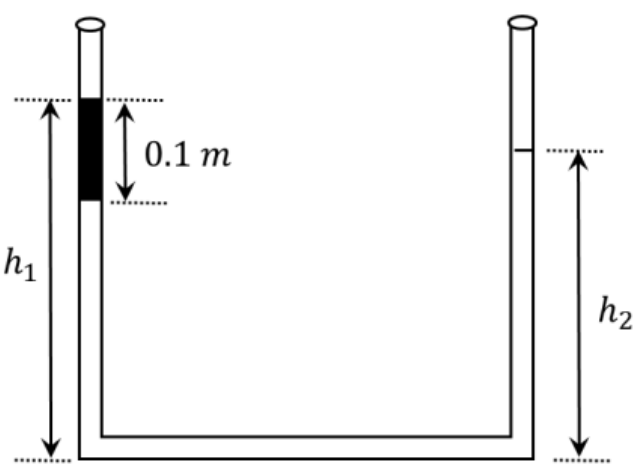
Options
Topics & Concepts
Step-by-Step Solution
To find the ratio of the fluid heights in the two limbs , we apply the principles of hydrostatic equilibrium for immiscible liquids in a U-tube.
1. Initial State:
Initially, water of density stands at a height of in both arms of the U-tube from the bottom.
2. Final State after adding Kerosene:
Kerosene of density and column length is poured into the left limb.
Because the U-tube has a uniform cross-sectional area:
- The water level in the left limb moves down by a distance .
- The water level in the right limb moves up by the same distance .
Thus:
- The height of the water column in the left limb from the bottom becomes:
- The height of the water column in the right limb from the bottom becomes:
3. Hydrostatic Pressure Balance:
Equating the hydrostatic pressure at the bottom of both limbs:
Canceling and from both sides:
Substitute the given numerical values (, , and ):
4. Calculating Heights and :
-
Total height of liquid in the left limb ():
-
Total height of liquid in the right limb ():
5. Ratio of Heights:
Thus, the correct option is (B).