Restoring Torque and Frequency of Pivoted Rod Disc SHM System
A metal rod of length ‘L’ and mass ‘m’ is pivoted at one end. A thin disk of mass ‘M’ and radius ‘R’ () is attached at its center to the free end of the rod. Consider two ways the disc is attached: (case A) The disc is not free to rotate about its center and (case B) the disc is free to rotate about its center. The rod-disc system performs SHM in vertical plane after being released from the same displaced position. Which of the following statement(s) is (are) true?
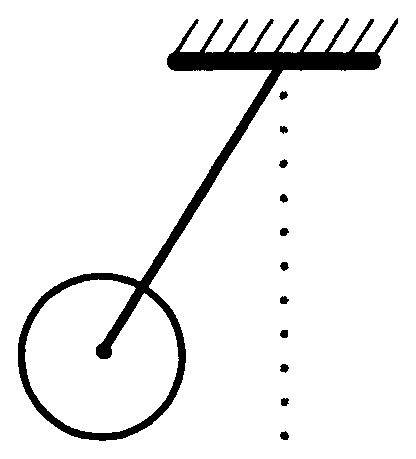
Options
Restoring torque in case A = Restoring torque in case B
Restoring torque in case A < Restoring torque in case B
Angular frequency for case A > Angular frequency for case B.
Angular frequency for case A < Angular frequency for case B.
Topics & Concepts
Step-by-Step Solution
To determine the correct statements, let us analyze the restoring torque and the angular frequency for both cases when the rod-disc system is displaced by a small angle from its vertical equilibrium position.
1. Restoring Torque Calculation
The center of mass of the rod (mass , length ) is located at a distance of from the pivot.
The center of mass of the disc (mass ) is located at a distance from the pivot.
The torque about the pivot due to gravity in both cases is given by:
For small angular displacements ():
Since the gravitational forces and their lines of action relative to the pivot are identical in both configurations:
Thus, the restoring torque in case A is equal to the restoring torque in case B.
This confirms that Option A is correct and Option B is incorrect.
2. Angular Frequency Calculation
Case A: The disc is NOT free to rotate about its center
As the rod rotates by an angle , the disc also rotates through the same angle . By the parallel axis theorem, the total moment of inertia about the pivot is:
Case B: The disc IS free to rotate about its center
Since the pivot at the center of the disc is frictionless, no torque acts on the disc about its center of mass. Therefore, the disc executes purely translational motion along an arc of radius without rotating about its own axis.
The total kinetic energy of the system is:
Thus, the effective moment of inertia about the pivot is:
Comparing the two moments of inertia:
Comparison of Angular Frequencies:
The angular frequency of small oscillations is given by .
-
For Case A:
-
For Case B:
Since , it follows that:
Thus, the angular frequency for case A is less than the angular frequency for case B.
This confirms that Option D is correct and Option C is incorrect.
Final Conclusion
The correct options are A and D.