Thermal Conductivity and Heat Flow in Composite Slabs
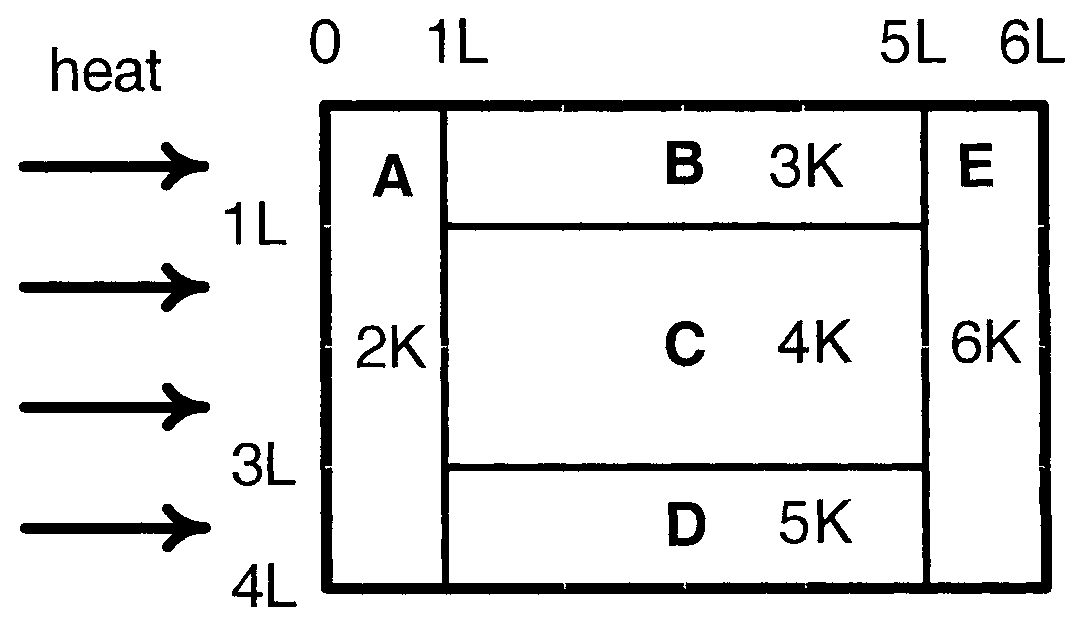
A composite block is made of slabs A, B, C, D and E of different thermal conductivities (given in terms of a constant K) and sizes (given in terms of length, L) as shown in the figure. All slabs are of same width. Heat ‘Q’ flows only from left to right through the blocks. Then in steady state
Options
heat flow through A and E slabs are same.
heat flow through slab E is maximum.
temperature difference across slab E is smallest.
heat flow through C = heat flow through B + heat flow through D.
Topics & Concepts
Step-by-Step Solution
To analyze the heat flow and temperature distribution across the composite block in the steady state, we can use the concept of thermal resistance, which is given by:
where is the length of the slab along the direction of heat flow, is the thermal conductivity, and is the cross-sectional area perpendicular to the heat flow. Let be the width of all the slabs (perpendicular to the plane of the diagram).
1. Geometrical and Thermal Parameters of Each Slab
From the given figure:
-
Slab A:
- Length
- Height
- Conductivity
- Thermal Resistance:
-
Slab B:
- Length
- Height
- Conductivity
- Thermal Resistance:
-
Slab C:
- Length
- Height
- Conductivity
- Thermal Resistance:
-
Slab D:
- Length
- Height
- Conductivity
- Thermal Resistance:
-
Slab E:
- Length
- Height
- Conductivity
- Thermal Resistance:
2. Evaluation of Options
Analysis of Option (A):
Slab A, the combination of slabs (B, C, D), and slab E are connected in series along the heat flow path.
In a series arrangement, the total rate of heat flow through each section must be equal to the total heat current :
Hence, the heat flow through slab A and slab E is the same ().
- Option (A) is CORRECT.
Analysis of Option (C):
Let be the total heat flow rate through the block.
-
Temperature difference across slab A:
-
Equivalent resistance of the parallel combination of slabs B, C, and D:
Thus, the temperature difference across the parallel section (BCD) is:
-
Temperature difference across slab E:
Comparing the temperature differences:
Therefore, the temperature difference across slab E is the smallest.
- Option (C) is CORRECT.
Analysis of Option (D):
Since slabs B, C, and D are connected in parallel, they experience the same temperature difference . The heat flow through each individual slab is:
Adding the heat flows through slab B and slab D:
Hence, heat flow through C = heat flow through B + heat flow through D.
- Option (D) is CORRECT.
Conclusion
The correct options are A, C, and D.