Refraction of Light at Meta Material Interface with Negative Index
Typically, materials possess a refractive index . Hence, whenever a light ray travels from air into a naturally occurring substance, according to Snell's law, , the refracted ray bends toward the normal. However, it never emerges on the same side of the normal as the incident ray. From the theory of electromagnetism, the refractive index of a medium is expressed by the relation in which denotes the speed of electromagnetic waves in vacuum, is its speed in the medium, and represent the medium's relative permittivity and relative permeability, respectively.
In conventional substances, both and are positive, implying a positive value of for the medium. When both and are negative, one must choose the negative root of . Such negative refractive index materials can now be synthesized artificially and are called meta-materials. They exhibit significantly different optical behavior, without violating any physical laws. Since is negative, it results in a change in the direction of propagation of the refracted light. However, similar to normal materials, the frequency of light remains unchanged upon refraction even in meta-materials.
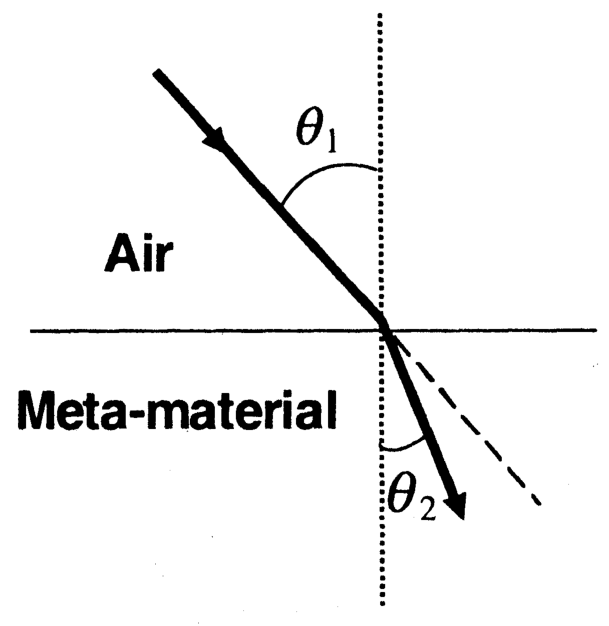
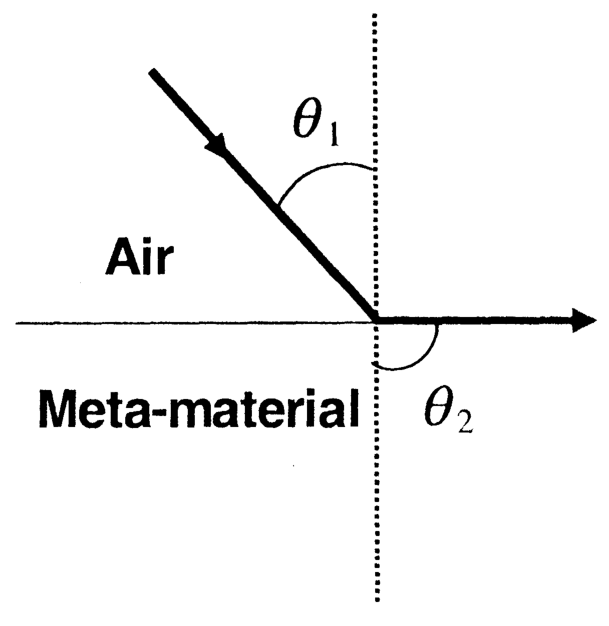
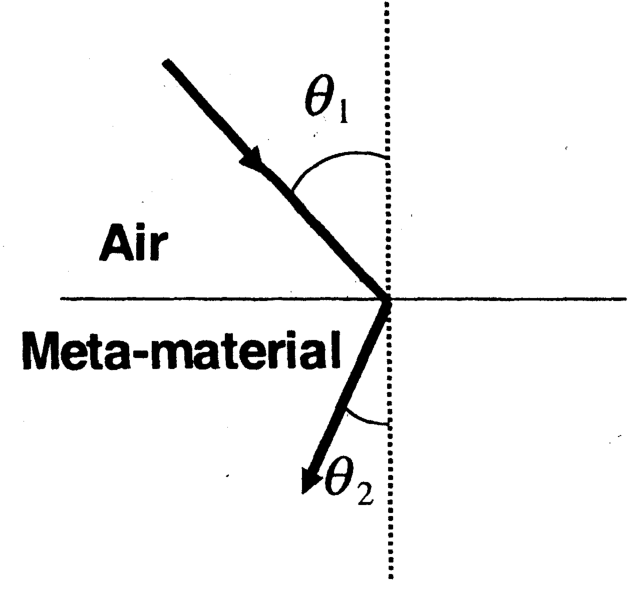
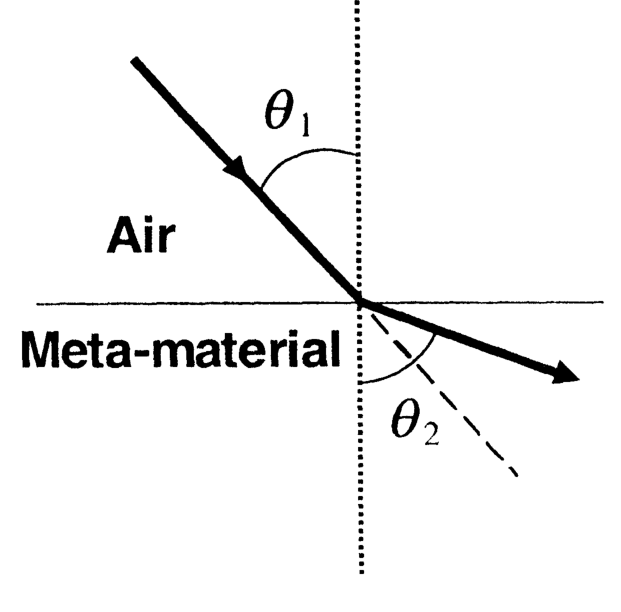
For light incident from air onto a meta-material, identify the appropriate ray diagram:
Options
Topics & Concepts
Step-by-Step Solution
According to Snell's law of refraction:
where:
- is the angle of incidence,
- is the angle of refraction,
- is the refractive index of the first medium (air, so ),
- is the refractive index of the second medium.
For a meta-material, the refractive index is negative, i.e., . Therefore, the ratio of the refractive indices is negative:
Since for a given positive incident angle with respect to the normal, it follows that:
A negative angle of refraction implies that the refracted ray is bent to the same side of the normal as the incident ray (negative refraction).
Looking at the given ray diagrams:
- In diagrams (A), (B), and (D), the refracted ray is on the opposite side of the normal relative to the incident ray, which corresponds to positive refractive indices.
- In diagram (C), the refracted ray lies on the same side of the normal as the incident ray, correctly representing a negative angle of refraction.
Therefore, the appropriate ray diagram is given in option (C).