Refraction at Spherical Boundary of Coated Glass Cylinder
A transparent thin film of uniform thickness and refractive index is coated on the convex spherical surface of radius at one end of a long solid glass cylinder of refractive index , as illustrated in the figure. Rays of light incident parallel to the cylinder's axis traveling through the film from air to glass come to a focus at a distance from the film, whereas rays traversing from glass to air get focused at a distance from the film. Then:
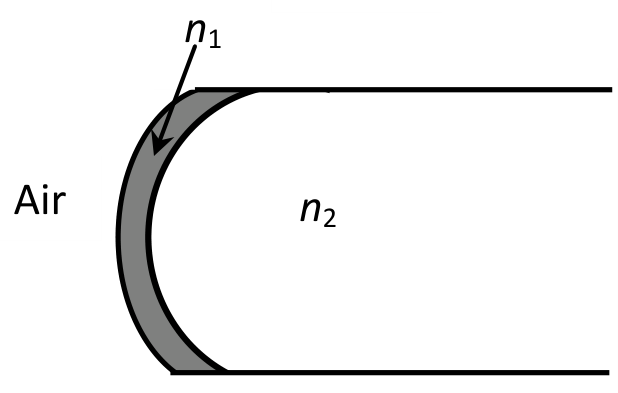
Options
Topics & Concepts
Step-by-Step Solution
To determine the focal lengths and , we consider the refraction of light through a spherical boundary between two media coated with a thin film.
Refraction at a Thin Coated Spherical Boundary
Since the coating is a thin film of uniform and negligible thickness (), the total refraction across the two interfaces (air-film and film-glass) can be analyzed by combining the refraction equations at each boundary:
-
Refraction at the first surface (medium to medium of radius ):
-
Refraction at the second surface (medium to medium of radius ):
Adding the two equations yields the net refraction formula, showing that the intermediate refractive index cancels out:
1. Rays traveling from Air to Glass ()
- Incident medium: Air ()
- Final medium: Glass ()
- Object distance: Parallel rays imply
- Radius of curvature: The surface is convex towards air, so its center of curvature lies inside the glass cylinder in the direction of light propagation ().
Using the refraction formula:
This matches Option (A).
2. Rays traveling from Glass to Air ()
- Incident medium: Glass ()
- Final medium: Air ()
- Object distance: Parallel rays inside the glass imply
- Radius of curvature: As light travels from glass to air, it encounters a surface that is concave relative to the incident direction. Therefore, the center of curvature lies opposite to the direction of light propagation ().
Using the refraction formula:
This matches Option (C).
Conclusion
The correct options are (A) and (C).