Static Equilibrium and Slipping Condition of a Leaning Ladder
In the figure, a uniform ladder of mass is depicted resting against a vertical wall in static equilibrium, making an angle with the horizontal floor. The coefficient of friction between the wall and the ladder is , and between the floor and the ladder is . The normal reaction force of the wall on the ladder is and that of the floor is . If the ladder is on the verge of slipping, then which of the following conditions holds true?
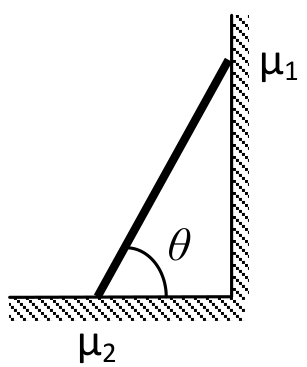
Options
, and
, and
, and
, and
Topics & Concepts
Step-by-Step Solution
To determine the correct conditions for static equilibrium when the ladder is on the verge of slipping, we analyze the forces acting on the uniform ladder of mass and length .
1. Analysis of Forces and Equilibrium Conditions
The forces acting on the ladder are:
- Weight of the ladder, , acting vertically downwards at its center of mass ( from either end).
- Normal reaction force from the floor, , acting vertically upwards.
- Friction force from the floor, , acting horizontally towards the wall.
- Normal reaction force from the wall, , acting horizontally away from the wall.
- Friction force from the wall, , acting vertically upwards.
Equilibrium Equations:
-
Horizontal Force Balance ():
-
Vertical Force Balance ():
-
Torque Balance about the Bottom Contact Point (): Dividing the entire torque equation by :
2. Evaluation of Options
Case 1: When and (Checking Option C)
When the ladder is on the verge of slipping, the frictional forces reach their maximum static limit:
From the horizontal equilibrium condition:
Substituting into the vertical equilibrium equation:
Thus, Option C is correct.
Case 2: When and (Checking Options A and D)
If the wall is smooth (), there is no friction force at the wall, i.e., .
Substituting into Equation 1:
Also, from vertical equilibrium:
Thus:
- Option D correctly gives .
- Option A incorrectly states .
Therefore, Option D is correct, while Option A is incorrect.
Case 3: When and (Checking Option B)
If the floor is smooth (), then , which implies . If , static equilibrium cannot be maintained because would require , but maximum possible friction at the wall is . Thus, the ladder cannot remain in equilibrium without floor friction.
Therefore, Option B is incorrect.
Conclusion
The correct options are C and D.