Reflection of Light Ray Inside Equilateral Triangular Mirror Box
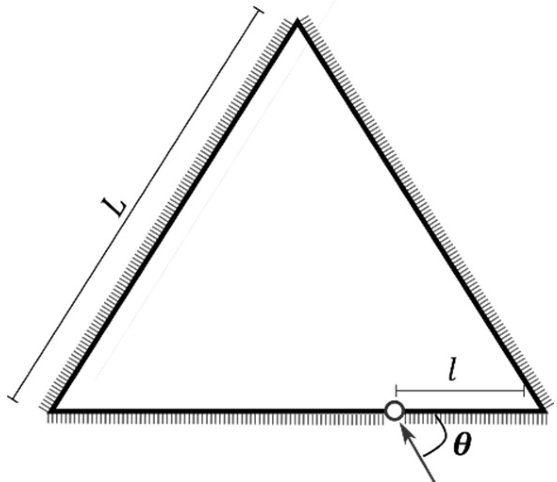
Three plane mirrors form an equilateral triangle with each side of length . There is a small hole at a distance from one of the corners as shown in the figure. A ray of light is passed through the hole at an angle and can only come out through the same hole. The cross section of the mirror configuration and the ray of light lie on the same plane.
Which of the following statement(s) is(are) correct?
Options
The ray of light will come out for , for .
There is an angle for at which the ray of light will come out after two reflections.
The ray of light will NEVER come out for , and .
The ray of light will come out for , and after six reflections.
Step-by-Step Solution
To determine which statement(s) is(are) correct, we analyze the path of the light ray inside the equilateral triangular mirror configuration using coordinate geometry and the law of reflection.
Let the vertices of the equilateral triangle of side length be placed in a Cartesian coordinate system as:
The equations of the three sides are:
- Base : for
- Left side : for
- Right side : for
The hole is located on the base mirror at a distance from corner , so its position is:
Analysis of Option A:
For , the ray enters through into the interior of the triangle at an angle of to the base (directed towards side ).
The angle of the ray with the positive x-axis is , so its direction vector is:
The line equation of the ray is:
To find the intersection point with the left mirror ():
Since , lies strictly on the side .
Now, check the angle of incidence on side :
- Slope of mirror :
- Slope of incoming ray:
The product of their slopes is:
Since the product of the slopes is , the ray strikes mirror at normal incidence ( to the mirror surface).
Upon normal incidence, the ray retraces its path completely back along the same line: It returns directly to and exits through the hole after reflection for any .
Thus, Option A is correct.
Analysis of Option B:
For , the hole is located at the midpoint of the base:
Let a ray enter through at an angle to the base (directed towards side ). Its direction vector inside the triangle is:
The line equation of the incoming ray is:
-
First Reflection (on side ): Intersection of ray with side (): Point is the midpoint of side . The reflected ray direction becomes horizontal to the right:
-
Second Reflection (on side ): The horizontal ray intersects side () at: Point is the midpoint of side . By the law of reflection, the reflected ray direction is directed downwards at :
-
Return to the Hole: The ray travels along the line: Setting gives , which is the exact location of the hole .
Thus, the ray comes out after two reflections.
Therefore, Option B is correct.
Analysis of Options C and D:
Consider a ray entering at for any distance . The hole position is .
Tracing the trajectory step-by-step:
- Segment 1 (): Starts at , hits side at 1st reflection.
- Segment 2 (): Reflects horizontally to side , hitting at 2nd reflection.
- Segment 3 (): Reflects downwards at to base , hitting at . Since (for ), , so it reflects off the bottom mirror 3rd reflection.
- Segment 4 (): Reflects upwards at to side , hitting at 4th reflection.
- Segment 5 (): Reflects horizontally to side , hitting at 5th reflection.
- Segment 6 (): Reflects downwards at to base , hitting at .
Since is the hole , the ray exits through the hole after traversing 6 path segments and undergoing 5 reflections.
- For , the ray will exit through the hole after 5 reflections. Thus, statement (C) claiming it will "NEVER come out" is incorrect.
- Statement (D) claims the ray comes out "after six reflections", but it exits after five reflections. Thus, statement (D) is incorrect.
Conclusion:
The correct statements are A and B.