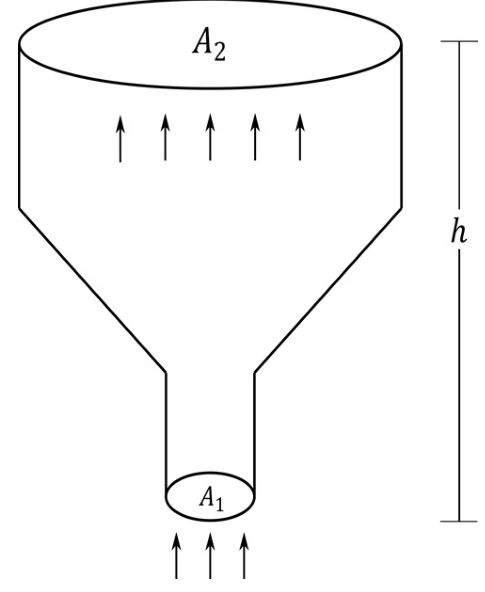
An ideal gas of density ρ=0.2 kg m−3 enters a chimney of height h at the rate of α=0.8 kg s−1 from its lower end, and escapes through the upper end as shown in the figure. The cross-sectional area of the lower end is A1=0.1 m2 and the upper end is A2=0.4 m2. The pressure and the temperature of the gas at the lower end are 600 Pa and 300 K, respectively, while its temperature at the upper end is 150 K. The chimney is heat insulated so that the gas undergoes adiabatic expansion. Take g=10 m s−2 and the ratio of specific heats of the gas γ=2. Ignore atmospheric pressure.
Which of the following statement(s) is(are) correct?
Options
A
The pressure of the gas at the upper end of the chimney is 300 Pa.
B
The velocity of the gas at the lower end of the chimney is 40 m s−1 and at the upper end is 20 m s−1.
Correct
C
The height of the chimney is 590 m.
D
The density of the gas at the upper end is 0.05 kg m−3.
To determine the correct statement(s), we analyze the adiabatic flow of the ideal gas through the chimney step-by-step.
1. Velocity at the Lower End (v1)
The mass flow rate α at the lower end is given by:
α=ρ1A1v1
Given:
α=0.8 kg s−1
ρ1=0.2 kg m−3
A1=0.1 m2
Substituting the values:
0.8=0.2×0.1×v1⟹v1=0.020.8=40 m s−1
2. Pressure at the Upper End (P2)
For a reversible adiabatic process of an ideal gas, the relation between pressure P and temperature T is given by:
P1−γTγ=constant⟹P∝Tγ−1γ
Given γ=2:
P∝T2−12=T2
Thus,
P1P2=(T1T2)2
Given P1=600 Pa, T1=300 K, and T2=150 K:
P2=600×(300150)2=600×41=150 Pa
Hence, Option A is incorrect.
3. Density at the Upper End (ρ2)
For an adiabatic process, pressure and density are related by:
P∝ργ⟹P1P2=(ρ1ρ2)γ
Given γ=2:
ρ1ρ2=P1P2=600150=21
ρ2=2ρ1=20.2=0.1 kg m−3
Hence, Option D is incorrect.
4. Velocity at the Upper End (v2)
Using the continuity equation for mass flow rate at the upper end:
α=ρ2A2v2
Given A2=0.4 m2 and ρ2=0.1 kg m−3:
0.8=0.1×0.4×v2⟹v2=0.040.8=20 m s−1
Thus, v1=40 m s−1 and v2=20 m s−1.
Hence, Option B is correct.
5. Height of the Chimney (h)
Applying the Steady Flow Energy Equation (SFEE) for an insulated chimney with no external work done:
h1+21v12+gz1=h2+21v22+gz2
where h1 and h2 represent the specific enthalpy of the gas (h=CpT). Taking z1=0 at the lower end and z2=h at the upper end:
CpT1+21v12=CpT2+21v22+gh
gh=Cp(T1−T2)+21(v12−v22)
First, we determine the specific gas constant Rs:
P1=ρ1RsT1⟹Rs=ρ1T1P1=0.2×300600=10 J kg−1K−1
The specific heat capacity at constant pressure Cp is:
Cp=γ−1γRs=2−12×10=20 J kg−1K−1
Now, substituting Cp, velocities, and g=10 m s−2:
10×h=20×(300−150)+21(402−202)