Electric Field and Potential of Charges around Regular Hexagon
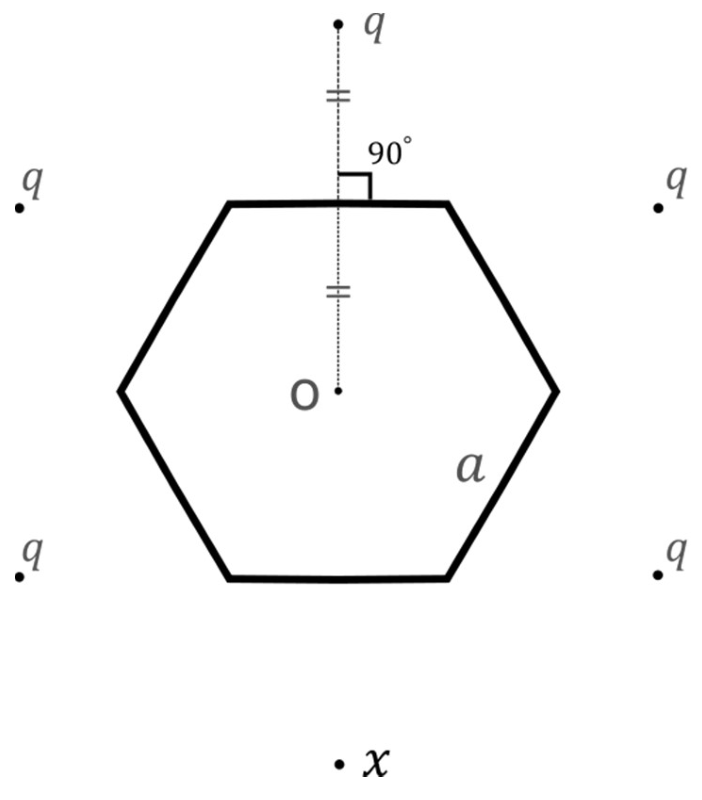
Six charges are placed around a regular hexagon of side length as shown in the figure. Five of them have charge , and the remaining one has charge . The perpendicular from each charge to the nearest hexagon side passes through the center of the hexagon and is bisected by the side.
Which of the following statement(s) is(are) correct in SI units?
Options
When , the magnitude of the electric field at is zero.
When , the magnitude of the electric field at is .
When , the potential at is .
When , the potential at is .
Step-by-Step Solution
To determine the correct statements, we first analyze the geometry of the charge configuration around the regular hexagon.
1. Distance of each charge from the center
For a regular hexagon of side length , the perpendicular distance from the center to any of its sides (the inradius ) is given by:
As given in the problem and shown in the diagram, the perpendicular segment from each charge to the nearest side passes through and is bisected by that side. This implies that the distance from the side to the charge is equal to the distance from to the side, which is .
Therefore, the total distance of each charge from the center is:
2. Analysis of Options
Option A:
When , six identical charges are positioned symmetrically around at equal angular intervals of at a uniform distance .
By central symmetry, the electric fields produced by diametrically opposite charges are equal in magnitude and opposite in direction, canceling each other out completely:
Thus, Option A is correct.
Option B:
When , five charges are and one charge is . By the principle of superposition, this distribution can be represented as:
- A symmetric distribution of six identical charges at distance from (which gives a net electric field of zero at ).
- An additional charge of located at the position of .
The magnitude of the net electric field at is therefore due to the effective charge of :
Substituting , so :
Thus, Option B is correct.
Option C:
The electric potential at the center is the scalar sum of the potentials due to all six charges:
For :
Thus, Option C is correct.
Option D:
For , using the formula for potential at :
This is not equal to .
Thus, Option D is incorrect.
Conclusion
The correct options are A, B, and C.