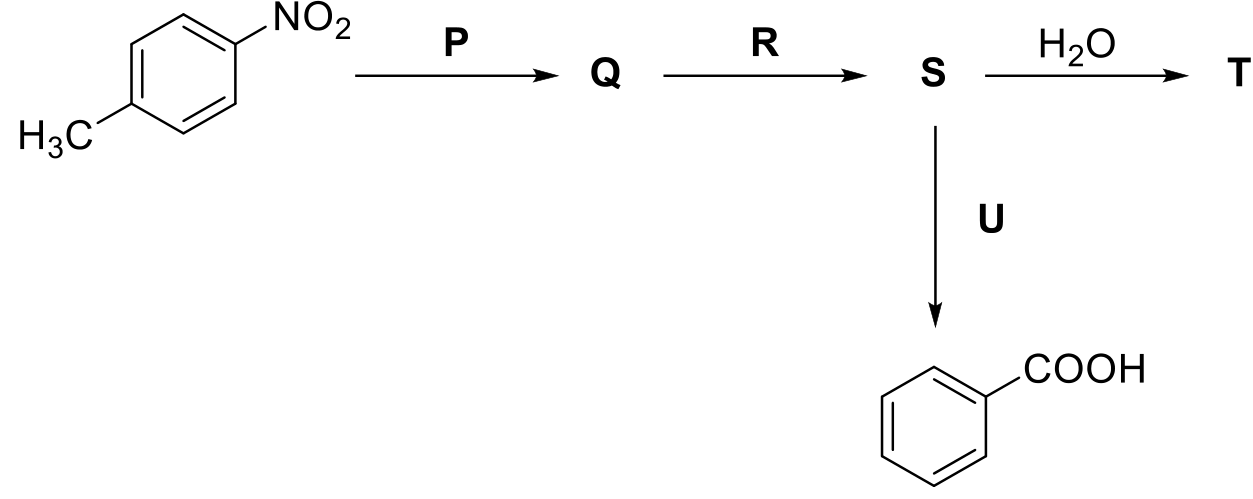
Reduction of the nitro group (−NO2) to an amino group (−NH2) can be achieved using reducing agents such as P=H2/Pd, ethanol or P=Sn/HCl.
This yields 4-methylaniline (p-toluidine, Q=p-CH3-C6H4-NH2).
Step 2 (QRS):
Diazotization of 4-methylaniline (Q) using R=NaNO2/HCl or HNO2 at low temperatures (0−5∘C) yields 4-methylbenzenediazonium chloride (S=p-CH3-C6H4-N2+Cl−).
Step 3 (SH2OT):
Hydrolysis of the diazonium salt (S) with warm water replaces the −N2+Cl− group with a hydroxyl group (−OH), producing 4-methylphenol (p-cresol, T=p-CH3-C6H4-OH).
Step 4 (SUBenzoic acid):
To convert 4-methylbenzenediazonium chloride (S) to benzoic acid (C6H5COOH), two transformations are required:
Deamination: The diazonium group (−N2+Cl−) is reduced to a hydrogen atom (−H) using either hypophosphorous acid (H3PO2) or ethanol (CH3CH2OH), forming toluene (C6H5CH3).
Oxidation: The methyl group (−CH3) of toluene is oxidized to a carboxylic acid group (−COOH) using alkaline potassium permanganate (KMnO4−KOH, heat) followed by acidification.
2. Verification of Options
Option (A):
P=H2/Pd, ethanol reduces −NO2 to −NH2.
R=NaNO2/HCl converts −NH2 to −N2+Cl−.
U=1.H3PO22.KMnO4−KOH, heat first reduces the diazonium group to yield toluene, then oxidizes toluene to benzoic acid.
Option (A) is CORRECT.
Option (B):
P=Sn/HCl reduces 4-nitrotoluene to 4-methylaniline (Q).
R=HNO2 diazotizes 4-methylaniline.
S=p-CH3-C6H4-N2+Cl− is correctly identified as the diazonium salt.
Option (B) is CORRECT.
Option (C):
S=p-CH3-C6H4-N2+Cl− is the diazonium salt.
T=p-CH3-C6H4-OH (p-cresol) is formed by heating S with water.
U=1.CH3CH2OH2.KMnO4−KOH, heat reduces S to toluene using ethanol, followed by oxidation to benzoic acid.
Option (C) is CORRECT.
Option (D):
If Q=4-nitrobenzoic acid, reduction with R=H2/Pd, ethanol gives 4-aminobenzoic acid, which on reaction with H2O does not give p-cresol (T). Thus, this path is incorrect.
 Correct
 Correct
 Correct