Match Rate Expressions of Decomposition with Concentration Profiles
Match the rate expressions in LIST-I for the decomposition of with the corresponding profiles provided in LIST-II. and are constants having appropriate units.
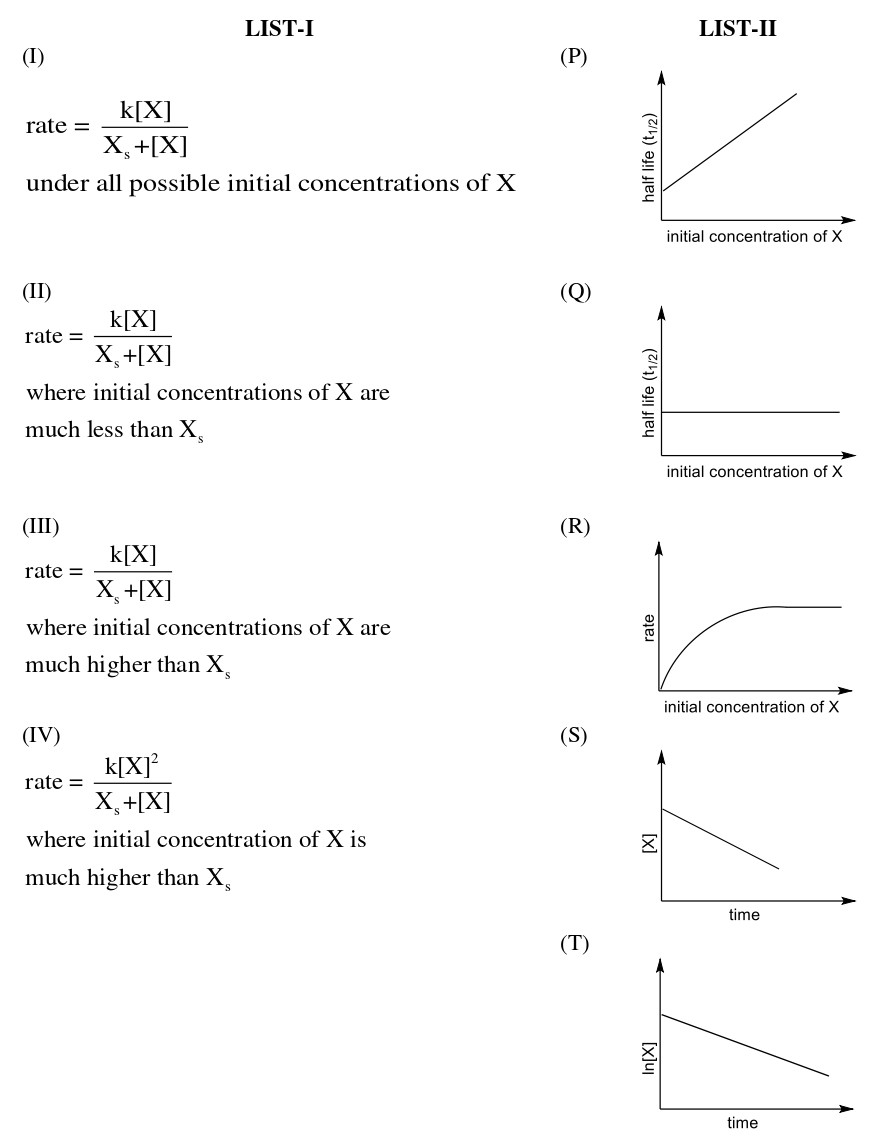
Options
\text{I} \rightarrow \text{P}; \text{II} \rightarrow \text{Q}; \text{III} \rightarrow \text{S}; \text{IV} \rightarrow \text{T}
\text{I} \rightarrow \text{R}; \text{II} \rightarrow \text{S}; \text{III} \rightarrow \text{S}; \text{IV} \rightarrow \text{T}
\text{I} \rightarrow \text{P}; \text{II} \rightarrow \text{Q}; \text{III} \rightarrow \text{Q}; \text{IV} \rightarrow \text{R}
\text{I} \rightarrow \text{R}; \text{II} \rightarrow \text{S}; \text{III} \rightarrow \text{Q}; \text{IV} \rightarrow \text{R}
Topics & Concepts
Step-by-Step Solution
To determine the correct matching between the rate expressions in LIST-I and the concentration profiles in LIST-II, let us analyze each expression step-by-step:
1. Item (I):
-
Low concentration regime (): The rate increases linearly with initial concentration .
-
High concentration regime (): The rate becomes constant (independent of initial concentration ) and reaches saturation.
-
Graphical Profile: A plot of Rate vs initial concentration starts linearly from the origin and curves to reach a horizontal asymptote (saturation plateau). This matches profile (R).
2. Item (II):
- Since , the rate law simplifies to:
- This represents a first-order reaction.
- For first-order kinetics:
- Integrated Rate Law: , which gives a linear plot of vs time (Profile T).
- Half-life: , which is independent of initial concentration (Profile Q).
3. Item (III):
- Since , the rate law simplifies to:
- This represents a zero-order reaction.
- For zero-order kinetics:
- Integrated Rate Law: , which means a plot of vs time is a straight line with a negative slope (Profile S).
- Half-life: , which is a straight line passing through the origin (Profile P).
4. Item (IV):
- Since , the denominator , so:
- This represents a first-order reaction.
- For first-order kinetics:
- Integrated Rate Law: , which corresponds to a straight line of vs time with a negative slope (Profile T).
Conclusion:
Matching the results:
Comparing with the given choices, Option (B) corresponds to these correct matches.
Correct Answer: (B)