Synthesis and Properties of Intermediate Compounds in Reaction Sequence
Considering the reaction sequence given below, the correct statement(s) is(are)
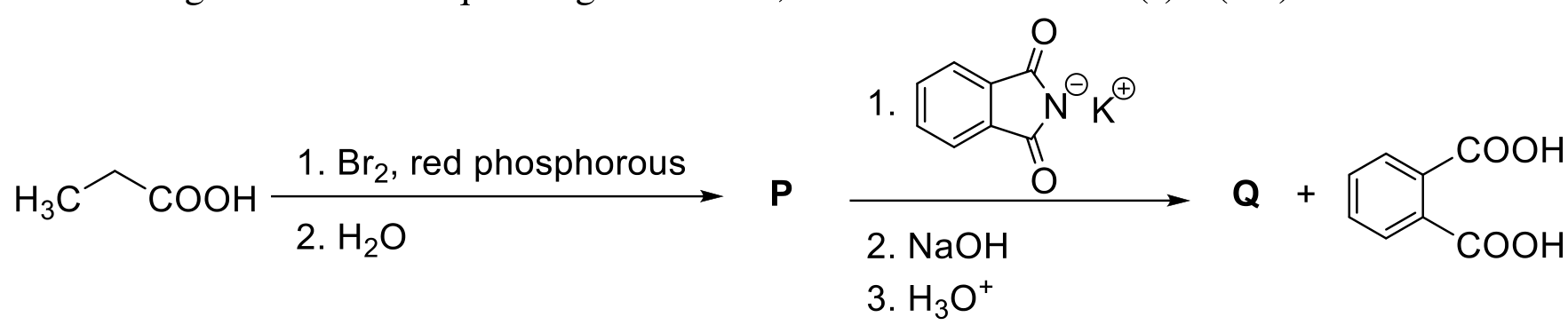
Options
can be reduced to a primary alcohol using .
Treating with conc. solution followed by acidification gives .
Treating with a solution of in aq. liberates .
is more acidic than .
Step-by-Step Solution
To determine the correct statement(s), let us analyze the given reaction sequence step-by-step:
Step 1: Identification of Compound
Propanoic acid () is treated with in the presence of red phosphorus followed by hydrolysis (). This is the Hell-Volhard-Zelinsky (HVZ) reaction, which selectively substitutes an -hydrogen with a bromine atom:
Thus, compound is -bromopropanoic acid ().
Step 2: Identification of Compound
Compound undergoes a modified Gabriel Phthalimide Synthesis:
- Reaction of -bromopropanoic acid with potassium phthalimide results in nucleophilic substitution () of the bromide group by the phthalimide ion, yielding -phthaloyl alanine.
- Subsequent alkaline hydrolysis () followed by acidification () cleaves the phthalimide adduct to form phthalic acid as a byproduct and alanine (-aminopropanoic acid) as compound .
Thus, compound is alanine (-aminopropanoic acid).
Evaluation of Options:
-
(A) can be reduced to a primary alcohol using : (sodium borohydride) is a mild reducing agent that reduces aldehydes, ketones, and acyl chlorides, but does not reduce carboxylic acids () to primary alcohols (which require stronger reducing agents like or ). Thus, Statement (A) is INCORRECT.
-
(B) Treating with conc. solution followed by acidification gives : Treatment of an -halo acid like -bromopropanoic acid () with excess concentrated ammonium hydroxide () leads to nucleophilic substitution of the group by an amino group (), producing alanine (). This is a standard laboratory method for synthesizing -amino acids. Thus, Statement (B) is CORRECT.
-
(C) Treating with a solution of in aq. liberates : Compound contains a primary aliphatic amino group (). Primary aliphatic amines react with nitrous acid (, generated in situ from ) to form an unstable aliphatic diazonium salt, which spontaneously decomposes to liberate nitrogen gas () quantitatively (Van Slyke reaction):
Thus, Statement (C) is CORRECT.
-
(D) is more acidic than : -bromopropanoic acid () contains a highly electronegative bromine atom at the -position relative to the carboxyl group. The electron-withdrawing inductive effect ( effect) of bromine stabilizes the conjugate base () to a greater extent than the unsubstituted propanoate ion. Hence, is significantly more acidic than propanoic acid (). Thus, Statement (D) is CORRECT.
Conclusion:
The correct statements are B, C, and D.